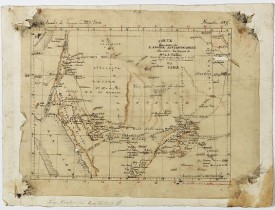
MALTE-BRUN, V.A. - Carte d'unne partie de l'Arabie Septentrionale Pour suivre les Voyages de Mr. G.A. Vallin. . .
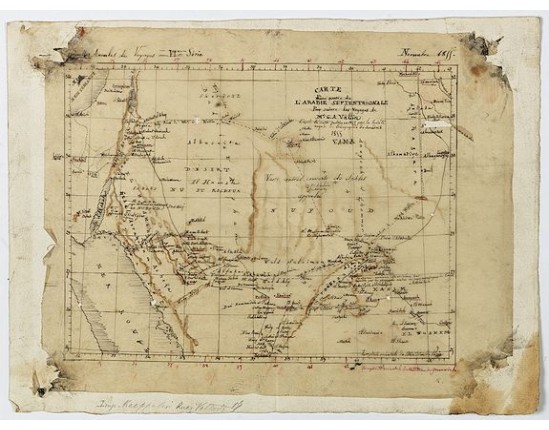
Date: Paris, November 1855
Format: 190 x 240mm.
Color: Col. ancien.
Condition: Pen and ink and body colour on thin paper, pasted on larger sheet. Paper with staining and some damage to paper.
Description
This is the original hand drawn map by Victor Adolphe Malte-Brun of "Carte d'unne partie de l'Arabie Septentrionale Pour suivre les Voyages de Mr. G.A. Wallin", of which the printed version was published in Nouvelles Annales des Voyages VI Série in November 1856.
With initials of Malte Brun underneath the title, who based his information on a map published by the London Geographical Society from the same year.
Georg August Wallin (1811-1852) - Yrjö Aukusti Wallin - alias Abd al-Wali, was born in the parish of Sund in Åland, the son of Johanna and Israel Wallin, a chief accountant and court scribe. Growing up in the archipelago, Wallin got involved with boats and sailing since a young age, and developed a love for the sea. When his father was appointed district accounting officer in Turku and Pori, the family moved to Turku, and then to Helsinki. During his years at the Turku Cathedral School in Wallin was taught several languages and he also studied languages on his own, acquiring knowledge of Latin, Greek, French, German, Russian, English, Arabic, Persian and Turkish.
Wallin entered the University of Helsinki in 1829, where he studied oriental languages, and received his M.A. in 1836. He then worked as a librarian at Helsinki University Library and continued his studies of Arabic and Persian. His teacher was Gabriel Geitlin, who was seven years his senior and had been appointed in 1835 professor of oriental languages.
After making his dissertation about Arabic in 1839, Wallin spent two years in St. Petersburg. There his teacher was Sheikh Muhammad Sayyad al-Tantawi (1810-61), whose tales of Egypt and the Arabs inspired the young scholar. Between 1843 and 1849 he conducted expeditions in Egypt, Arabia, Mesopotamia, Palestine, and Persia. It is also believed that Wallin adopted the Islamic faith. In Cairo he learned to play the Arab flute, spent a lot of time at coffee houses, ate with bare hands, and wrote to Geitlin: "What becomes of my appearance, and because of my real Arab beard, I am considered Oriental and Moslem..." Wallin did not live in celibate. Cairo and Paris offered him more opportunities for erotic adventures than Helsinki, which he fully utilized. He also recorded his affairs with Egyptian teenage girls in his writings. In Finland Wallin was labelled more as adventurer than a scholar and his scientific achievements were first ignored.
On his journeys Wallin, who was exceptionally dark for a Finn, presented himself as Abd al-Wali from Central Asia. He was the first European to reach al-Jauf and Ha'il. While in Medina, he visited the tombs of the Prophet Muhammad, the Prophet's daughter Fatima and the first Caliph, Abu Bakr. With the help of his disguise and knowledge of Arabic language and culture, Wallin entered on 7 December 1845 Mecca – a forbidden city for non-Moslems. One of the first Christians to visit the holy place was Ludovico de Varthema, who published an account of his travels, Itinerario de Ludouico de Varthema Bolognese, in 1510. Wallin did not describe his stay very thoroughly in his journal; Mecca was dirty, beggars were everywhere.
Like any other pilgrim, Wallin performed the rituals of Hajj. "I accomplished without fuss all that was required of me, so that now I am fully entitled to the designation of Hāgg. Apart from the vanity of being able to say that I am one of the three or four Europeans who ventured it, for future trips I dare say I shall have a real advantage from my pilgrimage." ('The terra incognita of Arabia' by Kaj Öhrnberg, in Dolce far niente in Arabia: Georg August Wallin and His Travels in the 1840s, 2014, p. 75) Originally Wallin did not plan to see the town but had to go there by force of circumstances.
In December 1846 Wallin started his second journey to the pilgrimage sites in the Holy Land. On his last expedition Wallin travelled via Taima and Tabuk to Bagdad and Persia. However, he did not visit the ruins of Persepolis on his way from Isfahan to Shiraz.
Wallin spent on his expedition over five year. On his journey through Europe he stayed a short time in Cologne. In the evening he went to hear Beethoven's Fidelio; the performance brought tears to his eyes. Wallin returned to Helsinki via London, where he published some of his studies, and was awarded with the gold medal of Royal Geographical Society in 1850. His study, Notes Taken During a Journey Through Part of Northern Arabia in 1848, was published next year by the Royal Geographical Society. Wallin was the first scholar to collect Bedouin poetry, his views on Arabic phonetics were highly valued by other researchers. However, most of his notes and letters Wallin wrote in Swedish, and his observations were not spread widely in the English speaking world.
In 1851 Wallin presented his doctoral thesis, Carmen elegiacum Ibnu-l-Faridi cum commentario Abdu-l-Ghanyi, and he was appointed professor of oriental literature. Wallin continued to arrange his research material, but his voyages to the Arabic lands were over. When the British and Russian geographical societies asked him to start a two years' expedition, Wallin rejected the offer because according to his plans, a new journey would take at least six years. Moreover, the Royal Geographical Society offered only £200; Wallin needed £400 at least. (Eventually the Society financed Sir Richard Francis Burton's expedition. His account of the journey, Personal Narrative of a Pilgrimage to Al-Madinah and Meccah, was published in 1855.) And Wallin did not like the idea that he should return through the Central Asia, which the Russians considered an obligatory part of the project.
Wallin died on October 23, 1852, three years after his return to Finland. According to some speculations, he died of syphilis, which was not the official cause of death – he died of heart failure. Wallin contracted it possibly in Paris, where he was beaten and robbed, or most likely in Cairo. During his journeys Wallin bought 34 books and 19 manuscripts for Helsinki University Library, but they were not catalogued for over a hundred years. Wallin's portrait was painted by R.W. Ekman in 1853.
G.A. Wallin was among the first Westerners to enter the holy Islamic places and his adventures created similar legend around him as T.E. Lawrence's (Lawrence of Arabia) acquired through activities in Near East. However, Wallin's interest in Arabia was more influenced by 'Drang nach Osten' movement, which romanticized the Bedouin culture, than curiosity about the forbidden towns. He considered European culture oppressive, and this feeling only strengthened during the years he spent in Arabia as an romantic, nomadic adventurer, and fulfilling the dreams of exotic escapism. On his return he wrote: "I felt, that couldn't adapt myself to Europe any more" – he was ready to turn back and spend the rest of his life in the Orient. Wallin enjoys great esteem in the Middle East. Many believe that he truly embraced Islam instead of just disguising himself as a Muslim.
Victor Adolphe Malte-Brun (1816 – July 13, 1889) was a French geographer and cartographer. He was born in Paris, France. The son of Conrad Malte-Brun, another geographer, of Danish origin, and founder of the Société de Géographie.
He was followed by his son Victor Adolphe, who in 1851 became a member of the Société de Géographie, and quickly rose to be its secretary-general.
The Société de Géographie (French, "Geographical Society"), is the world's oldest geographical society. The Society was founded at a meeting, 15 December 1821, and among its 217 founders were some of the greatest scientific names of the time: Pierre-Simon Laplace, the Society's first president; Georges Cuvier, Alexander von Humboldt , Charles Pierre Chapsal, etc . Most of those men who had accompanied Napoleon Bonaparte in his Egyptian expedition, among them Conrad Malte-Brun, Jules Dumont d'Urville, Jules Paul Benjamin Delessert, Hottinguer, Henri Didot, Bottin and others.
The Society's revue has appeared since 1822, monthly, as Bulletin de la Société de Géographie (1822-1899)—offering in octavo format early news of all the discoveries of the nineteenth century—or quarterly, as La Géographie, with a break in 1940-46. Since 1947 the Society's magazine has appeared three times a year, as Acta Geographica. Victor Adolphe Malte-Brun took over the editor ship of his father and he made all maps for the magazine, mostly after the most up-to-date information directly supplied by the great French and foreign explorers. The Society's library, map collection and photograph collection are among the world's most comprehensive and deepest.
A mountain of New Zealand, in the Southern Alps on South Island also bears his name: Mount Maltebrun.
With initials of Malte Brun underneath the title, who based his information on a map published by the London Geographical Society from the same year.
Georg August Wallin (1811-1852) - Yrjö Aukusti Wallin - alias Abd al-Wali, was born in the parish of Sund in Åland, the son of Johanna and Israel Wallin, a chief accountant and court scribe. Growing up in the archipelago, Wallin got involved with boats and sailing since a young age, and developed a love for the sea. When his father was appointed district accounting officer in Turku and Pori, the family moved to Turku, and then to Helsinki. During his years at the Turku Cathedral School in Wallin was taught several languages and he also studied languages on his own, acquiring knowledge of Latin, Greek, French, German, Russian, English, Arabic, Persian and Turkish.
Wallin entered the University of Helsinki in 1829, where he studied oriental languages, and received his M.A. in 1836. He then worked as a librarian at Helsinki University Library and continued his studies of Arabic and Persian. His teacher was Gabriel Geitlin, who was seven years his senior and had been appointed in 1835 professor of oriental languages.
After making his dissertation about Arabic in 1839, Wallin spent two years in St. Petersburg. There his teacher was Sheikh Muhammad Sayyad al-Tantawi (1810-61), whose tales of Egypt and the Arabs inspired the young scholar. Between 1843 and 1849 he conducted expeditions in Egypt, Arabia, Mesopotamia, Palestine, and Persia. It is also believed that Wallin adopted the Islamic faith. In Cairo he learned to play the Arab flute, spent a lot of time at coffee houses, ate with bare hands, and wrote to Geitlin: "What becomes of my appearance, and because of my real Arab beard, I am considered Oriental and Moslem..." Wallin did not live in celibate. Cairo and Paris offered him more opportunities for erotic adventures than Helsinki, which he fully utilized. He also recorded his affairs with Egyptian teenage girls in his writings. In Finland Wallin was labelled more as adventurer than a scholar and his scientific achievements were first ignored.
On his journeys Wallin, who was exceptionally dark for a Finn, presented himself as Abd al-Wali from Central Asia. He was the first European to reach al-Jauf and Ha'il. While in Medina, he visited the tombs of the Prophet Muhammad, the Prophet's daughter Fatima and the first Caliph, Abu Bakr. With the help of his disguise and knowledge of Arabic language and culture, Wallin entered on 7 December 1845 Mecca – a forbidden city for non-Moslems. One of the first Christians to visit the holy place was Ludovico de Varthema, who published an account of his travels, Itinerario de Ludouico de Varthema Bolognese, in 1510. Wallin did not describe his stay very thoroughly in his journal; Mecca was dirty, beggars were everywhere.
Like any other pilgrim, Wallin performed the rituals of Hajj. "I accomplished without fuss all that was required of me, so that now I am fully entitled to the designation of Hāgg. Apart from the vanity of being able to say that I am one of the three or four Europeans who ventured it, for future trips I dare say I shall have a real advantage from my pilgrimage." ('The terra incognita of Arabia' by Kaj Öhrnberg, in Dolce far niente in Arabia: Georg August Wallin and His Travels in the 1840s, 2014, p. 75) Originally Wallin did not plan to see the town but had to go there by force of circumstances.
In December 1846 Wallin started his second journey to the pilgrimage sites in the Holy Land. On his last expedition Wallin travelled via Taima and Tabuk to Bagdad and Persia. However, he did not visit the ruins of Persepolis on his way from Isfahan to Shiraz.
Wallin spent on his expedition over five year. On his journey through Europe he stayed a short time in Cologne. In the evening he went to hear Beethoven's Fidelio; the performance brought tears to his eyes. Wallin returned to Helsinki via London, where he published some of his studies, and was awarded with the gold medal of Royal Geographical Society in 1850. His study, Notes Taken During a Journey Through Part of Northern Arabia in 1848, was published next year by the Royal Geographical Society. Wallin was the first scholar to collect Bedouin poetry, his views on Arabic phonetics were highly valued by other researchers. However, most of his notes and letters Wallin wrote in Swedish, and his observations were not spread widely in the English speaking world.
In 1851 Wallin presented his doctoral thesis, Carmen elegiacum Ibnu-l-Faridi cum commentario Abdu-l-Ghanyi, and he was appointed professor of oriental literature. Wallin continued to arrange his research material, but his voyages to the Arabic lands were over. When the British and Russian geographical societies asked him to start a two years' expedition, Wallin rejected the offer because according to his plans, a new journey would take at least six years. Moreover, the Royal Geographical Society offered only £200; Wallin needed £400 at least. (Eventually the Society financed Sir Richard Francis Burton's expedition. His account of the journey, Personal Narrative of a Pilgrimage to Al-Madinah and Meccah, was published in 1855.) And Wallin did not like the idea that he should return through the Central Asia, which the Russians considered an obligatory part of the project.
Wallin died on October 23, 1852, three years after his return to Finland. According to some speculations, he died of syphilis, which was not the official cause of death – he died of heart failure. Wallin contracted it possibly in Paris, where he was beaten and robbed, or most likely in Cairo. During his journeys Wallin bought 34 books and 19 manuscripts for Helsinki University Library, but they were not catalogued for over a hundred years. Wallin's portrait was painted by R.W. Ekman in 1853.
G.A. Wallin was among the first Westerners to enter the holy Islamic places and his adventures created similar legend around him as T.E. Lawrence's (Lawrence of Arabia) acquired through activities in Near East. However, Wallin's interest in Arabia was more influenced by 'Drang nach Osten' movement, which romanticized the Bedouin culture, than curiosity about the forbidden towns. He considered European culture oppressive, and this feeling only strengthened during the years he spent in Arabia as an romantic, nomadic adventurer, and fulfilling the dreams of exotic escapism. On his return he wrote: "I felt, that couldn't adapt myself to Europe any more" – he was ready to turn back and spend the rest of his life in the Orient. Wallin enjoys great esteem in the Middle East. Many believe that he truly embraced Islam instead of just disguising himself as a Muslim.
Victor Adolphe Malte-Brun (1816 – July 13, 1889) was a French geographer and cartographer. He was born in Paris, France. The son of Conrad Malte-Brun, another geographer, of Danish origin, and founder of the Société de Géographie.
He was followed by his son Victor Adolphe, who in 1851 became a member of the Société de Géographie, and quickly rose to be its secretary-general.
The Société de Géographie (French, "Geographical Society"), is the world's oldest geographical society. The Society was founded at a meeting, 15 December 1821, and among its 217 founders were some of the greatest scientific names of the time: Pierre-Simon Laplace, the Society's first president; Georges Cuvier, Alexander von Humboldt , Charles Pierre Chapsal, etc . Most of those men who had accompanied Napoleon Bonaparte in his Egyptian expedition, among them Conrad Malte-Brun, Jules Dumont d'Urville, Jules Paul Benjamin Delessert, Hottinguer, Henri Didot, Bottin and others.
The Society's revue has appeared since 1822, monthly, as Bulletin de la Société de Géographie (1822-1899)—offering in octavo format early news of all the discoveries of the nineteenth century—or quarterly, as La Géographie, with a break in 1940-46. Since 1947 the Society's magazine has appeared three times a year, as Acta Geographica. Victor Adolphe Malte-Brun took over the editor ship of his father and he made all maps for the magazine, mostly after the most up-to-date information directly supplied by the great French and foreign explorers. The Society's library, map collection and photograph collection are among the world's most comprehensive and deepest.
A mountain of New Zealand, in the Southern Alps on South Island also bears his name: Mount Maltebrun.
3 000€
- N° Reference: 42924
Some of the most asked FAQ by our clients
Librairie Loeb-Larocque specializes in maps, atlases, and travel books from the 16th to 19th centuries.
The Librairie was founded in 1958 by Louis Loeb-Larocque. Originally, he arrived in France from Germany shortly after World War II. He started an antiquarian map and book shop in Paris, specializing in early maps, atlases, travel books, and prints. The shop was located at Rue Le Peletier until 1996, and was frequently visited by collectors and fellow dealers from all parts of the world.
At present, the office is located at 31 rue de Tolbiac in Paris in the lively 13th district, a 5-minute walk from the Bibliothéque Nationale de France (Metro Line 14)
Visitors are welcome to our shop by appointment, Monday through Friday.
The Librairie was founded in 1958 by Louis Loeb-Larocque. Originally, he arrived in France from Germany shortly after World War II. He started an antiquarian map and book shop in Paris, specializing in early maps, atlases, travel books, and prints. The shop was located at Rue Le Peletier until 1996, and was frequently visited by collectors and fellow dealers from all parts of the world.
At present, the office is located at 31 rue de Tolbiac in Paris in the lively 13th district, a 5-minute walk from the Bibliothéque Nationale de France (Metro Line 14)
Visitors are welcome to our shop by appointment, Monday through Friday.
Librairie Loeb-Larocque sells authentic maps, prints, atlases, and rare books. We guarantee the authenticity and condition of each lot listed in our catalogs.
Browse the catalog now >>>
We supply a certificate for each item sold. Librairie Loeb-Larocque guarantees the authenticity and condition of each lot described in our catalogs.
The warranty has no time limit. Defects in lots offered for sale have been carefully noted.
The value of any rare book, atlas, globe, print, or map is affected by many factors: its rarity, condition, binding, provenance, and the significance of any inscriptions it may contain.
Béatrice Loeb-Larcque, an expert and member of the Syndicat Français des Experts Professionnels en Œuvres d'Art et Objets de Collection, provides a free appraisal if you are considering selling.
We provide auction estimates based on photographs sent via the Internet. These estimates are not for valuation purposes and are subject to revision upon inspection of the object.
It is impossible to provide verbal estimates by telephone, nor can we respond to requests sent without a photo.
There is no easy answer to this question. Some books or maps have, without question, appreciated considerably in value over the years.
Others have remained steadily desirable without seeing a significant rise in price, and still others can be purchased for little money but give great personal satisfaction.
Librairie Loeb-Larocque, with 60 years of experience in the rare map and book trade, can help you decide what kind of collection you would like to build.
Others have remained steadily desirable without seeing a significant rise in price, and still others can be purchased for little money but give great personal satisfaction.
Librairie Loeb-Larocque, with 60 years of experience in the rare map and book trade, can help you decide what kind of collection you would like to build.
Nous recherchons en permanence pour nos clients et notre stock des ouvrages et cartes rares dans nos domaines de spécialités : atlas, cartes géographiques, voyages et livres illustrés.
Si vous avez des ouvrages et des cartes à vendre dans l’un de ces domaines, ou bien une bibliothèque complète, veuillez consulter la liste ci-dessous, qui vous donnera un aperçu de ce que nous recherchons.
DO A FREE APPRAISAL >>>
Si vous avez des ouvrages et des cartes à vendre dans l’un de ces domaines, ou bien une bibliothèque complète, veuillez consulter la liste ci-dessous, qui vous donnera un aperçu de ce que nous recherchons.
DO A FREE APPRAISAL >>>
Nos locaux sont situés au 31 rue de Tolbiac, dans le 13ème arrondissement de Paris, à 300 m du métro Bibliothèque François Mitterrand (ligne 14).
Nous recevons exclusivement sur rendez-vous du lundi au vendredi de 9h à 19h..
CONTACT US
Nous recevons exclusivement sur rendez-vous du lundi au vendredi de 9h à 19h..
CONTACT US