|
| |
|
|
ATLAS - COSMOGRAPHIES - VOYAGES |
ATLAS
|
| |
8 JACOBUS PHILIPPUS DE BERGAMO. Supplementum. Supplementi de la Chroniche vulgare novamante agionto & emendato al anno 1503. Venise, Georgio de Rusconi , 7 aout 1508. In-folio. Titre imprimé en rouge et noir avec une grande vignette gravée sur bois figurant saint Georges, deux grands bois représentant la création d'Eve, et Adam et Eve chassés du Paradis (les deux repris de l'édition de 1503), début du texte dans un bel encadrement vénitien, deux bois d'une demi-page figurant Cain tuant son frère et la construction de la Tour de Babel, et 90 vues de villes. (Taches, anciennes restaurations a la page de titre et sur quelques feuillets sans perte de texte.) Vélin ivoire du XVIIe siècle (mors partiellement fendus). 295 x 200 mm. Inquire about item N°25127 .
| |
10000 €
| | |
¤
BELLE EDITION, RICHEMENT ILLUSTREE, du texte qui contient en outre la relation des découvertes de Christophe Colomb en 1493. "De quatro grandissime isole in India fuora del circuito della terra de novo trovate" (feuillet v8 verso). Les bois figurent des vues de Rome, Milan, Tripoli, Jérusalem, Paris, Gênes, Lisbonne, Fiesole, Ravenne, Venise, Alexandrie, Florence, Naples, Verone, etc.
- Interesting Italian text edition of this important chronicle, first published in Latin in 1483. With large woodcut title-border, woodcut border on leaf A1 and 107 (2 full-page) woodcuts with city views in several sizes including a version of the 'T-O' world map (Shirley, world plate 2).
Page 342 including an account of the discovery of America under the year 1493. - Some browning, spotting and thumbing, few marginal tears, partly restored. 18th century vellum, somewhat soiled, small restorations to spine. Richly illustrated Chronicle with a very nice full page wood block engraving of Adam and Eve, Tower of Babel, and 90 town views of Rome, Milan, Tripoli, Jerusalem, Paris, Geneva, Lisbonne, Fiesole, Ravenna, Venise, Alexandrie, Florence, Naples, Verone, Alexandria, Lissabon, Constantinople. Giacomo Filippo Foresti da Bergamo (1434-1520) was an Augustinian monk, known as the author of several significant early printed works. He was a chronicler and Biblical scholar.
|
|
|
|
| |
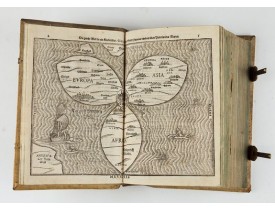
9 BÜNTING, Heinrich. Itinerarium Sacrae Scripturae, das ist, eine Reisebuch über die gantze Heilige Schrifft in zwey Bücher getheilt, de monetis et mensuris sacrae scripturae. Magdebourg, Paul Donat, 1595. In-folio. illustration : dans la première partie, 5 cartes sur doubles pages, une carte simple, deux cartes pliées et les plans de Jérusalem et de son temple, et dans la troisième partie, une carte simple et une carte dépliante, soit au total 12 belles cartes xylographiées. Reliure allemande de l'époque. Peau de truie sur ais, multiple encadrement à portraits et médaillons protestants, fermoirs et attaches. 316 x 195 mm. Inquire about item N°63065 .
| |
15000 €
| | |
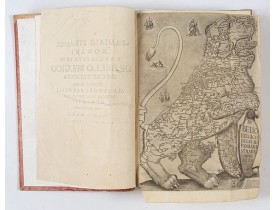
¤ Réimpression de l'édition de Magdebourg parue en 1581, cette description géographique de la Terre Sainte étudie dans la Bible et les livres apocryphes les mesures de distance bibliques, les noms des lieux bibliques, Jérusalem, ses murs et portes, et les toponymes que l'on trouve dans le Nouveau Testament. Ce volume contient également le travail de Bünting sur les monnaies et mesures bibliques. Les cartes incluent une représentation du monde en forme de feuille de trèfle (Shirley, 142), la caricature de l'Asie sous forme de Pégase et de l'Europe sous forme de reine.
|
|
|
|
| |
10 ORTELIUS, A. Theatrum orbis terrarum. Antwerp, Vrients, 1603. In attractive original colours. 3 parts in one volume (including the 'Parergon' and 'Nomenclator'), folio (45 x 31cm). Mounted on guards throughout. With full period hand-colouring throughout. Hand-coloured engraved allegorical general title, with full-page engraving of the arms Philip II of Spain on the verso, engraved full-page memorial to Ortelius incorporating a small circular portrait of him, full-page engraved portrait of Ortelius by Phillip Galle, hand-coloured engraved section-title to the Parergon with architectural surround, uncoloured engraved vignette on letterpress section title to the Nomenclator.
156 double-page hand-coloured engravings on 151 mapsheets (including 38 in the Parergon, 2 costume plates, 3 views), numerous woodcut initials. 450 x 310 mm. Inquire about item N°32198 .
| |
165000 €
| | |
¤ The publication of the Theatrum Orbis Terrarum in 1570 marked an epoch in the history of cartography. ”It was the first uniformly sized, systematic collection of maps of the countries of the world based only on contemporary knowledge since the days of Ptolemy, and in that sense may be called the first modern atlas.” – R.V. Tooley.
”It's great commercial success enabled it to make a great contribution to geographical culture throughout Europe at the end of the sixteenth century”- Skelton. Shape and contents set the standard for later atlases, when the centre of the map trade moved from Antwerp to Amsterdam.
The Theatrum consists of two elements; text and maps. Ortelius reduced the best available maps to a uniform format. Further, the Theatrum was the first major printed work of any kind to include scholarly citations of authorities (i.e. the original mapmakers), thus introducing for the first time the concept of footnoting to Western scholarship. Beside this he added the names of many other carthographers and geographers to his list. This "Catalogus auctorum tabularum geographicarum", is one of the major peculiarities of the atlas. Ortelius and his successors kept his list of map authors up-to-date. In the first edition of 1570 the list included 87 names. In this posthumous edition of 1603, it contained 183 names.Nomenclator Ptolemaicus Ortelius interest in history is seen in the addition of the Nomenclator Ptolemaicus, with its own, this was a list of placenames, areas, islands, etc., taken from Ptolemy's Geographia, and their modern equivalents. The atlas also contains De Mona Druidum Insula…Epistola. a six folio pages letter by the British geographer Humphrey Llwyd with a description of the islands of Anglesey and Man. All Latin editions contained these scientific appendices which Ortelius apparently regarded as unnecesary in most other editions.
The first edition including his bibliography.
Abraham Ortelius was one of the most prominent citizens of Antwerp at a time when this city was a major trading centre of Europe and indeed of the world. His first biography was written shortly after his death in the form of a book of mourning, entitled Insignium huius aevi poetarum lacrymae, in obytum Cl.V. Abrahami Ortelii, Antverpiani. Its author was his good friend Francis Sweertius, and it appeared in 1601. This Latin edition of 1603 was the first edition including a summarised version of this bibliography of Ortelius and the section is followed by a engraved full-page memorial to Ortelius incorporating a small circular portrait of him.
Parergon
Ortelius further included a massive appendix (the Parergon), consisting of a detailed classical atlas, to appeal to Renaissance Europe's fascination with the ancient world.
In fact, this collection of maps of the ancient world was so significant that it became the model for all historical atlases published throughout the seventeenth century. ”The maps and plates in the Parergon have to be evaluated as the most outstanding engravings depicting the wide-spread interest in classical geography in the 16th century” - Koeman.
Unlike the Theatrum, which consisted of existing maps reduced by Ortelius, the maps in the Parergon were drawn by Ortelius himself. As a scholar of antiquity, a dealer in antiques, and a visitor to ancient sites, he was well prepared to execute the maps and all the maps from the Parergon reflect his passion for the ancient world.
Ortelius’s Parergon began as a companion to his Theatrum but eventually it became an independent work.
Abraham Ortelius himself drew all his maps in manuscript before passing them to the engravers Frans Hogenberg, Ambrosius - and Ferdinand Arsenius.
The Theatrum was printed at Ortelius's expense. The heirs of Ortelius sold the copperplates and the publication right in 1601 to Jan Baptist Vrients, who added some new maps. After 1612, the year of Vrient's death, the copperplates passed to the Moretus brothers, the successors of Christoffel Plantin.
Theatrum orbis terrarum,
Antwerp: Jan Baptist Vrients, 1603.
3 parts in one volume (including the 'Parergon' and 'Nomenclator'), folio (45 x 31cm). Mounted on guards throughout. With full period hand-colouring throughout. Hand-coloured engraved allegorical general title, with full-page engraving of the arms of Philip II of Spain on the verso, engraved full-page memorial to Ortelius incorporating a small circular portrait of him, full-page engraved portrait of Ortelius by Phillip Galle, hand-colored engraved section-title to the Parergon with architectural surround, uncoloured engraved vignette on letterpress section title to the Nomenclator. 156 double-page hand-coloured engravings on 151 mapsheets (including 38 in the Parergon, 2 costume plates, 3 views), numerous woodcut initials.
 Contemporary brown calf, covers bordered and panelled in gilt and blind, covers with a large central design in gilt, spine in seven compartments with raised bands, blind ruled in gilt on either side of each band, compartments with date "1603" and title "ORTELLI THEATRVM ORBIS". The front and back cover are richly tooled with center piece. Front cover has "THEA / TRUM OR / BIS TER / RARUM". Verso a center piece with a figure of Goddess of justice surrounded by a motto QUOD TIBI FIERI NON VIS ALTERI NE FECERIS ("Do unto others as you would have done unto you.") The gilt has been faded but is still partly visible. With expert restoration at board edges.
Throughtout the book the upper right margin with light foxing and several pages with expert marginal reinforcement of paper, with the usual light browning of paper. Altogether a very attractive copy, with broad margins, very attractive original colouring and attractive binding.
Examples in bright original colouring and still in a fine contemporary, and richly tooled binding are rare now-a-days. This is a very fine example of Ortelius's Renaissance masterwork: the first true atlas, here with bright and full contemporary hand colouring. This Latin edition published by Jan Baptist Vrients is one of the most complete issues of the 'Theatrum Orbis' and includes both the 'Parergon' and 'Nomenclator.
Marcel v.d.Broecke estimates that 300 copies of this edition are printed.
The Theatrum… of Abraham Ortelius was one of the most brilliant and innovative of all Renaissance books. It was the first true atlas in the modern sense of the word, and as such, it introduced an entirely new and standardized method for the study of geography. For the first time in one volume, all parts of the globe were treated in a comprehensive and uniform manner, and thus it presented as complete a picture as was then possible of the whole world.
Ortelius published editions of his atlas not only in Latin, the traditional language of the scholarly elite, but in the six major European vernaculars: German, Dutch, French, Italian, English and Spanish. The Theatrum was therefore equally at home in the library of a scholar in Paris, a country gentleman in Kent, or a merchant in Grenada. This widespread dissemination had profound results in an age when geographical knowledge was in a rudimentary state: the information laid out in the Theatrum became the universally accepted vision of the world.
Another strategy used to make the atlas more accessible to the public was the inclusion of beautiful embellishments in the popular mannerist style, thus appealing to contemporary aesthetic tastes, and aligning the Theatrum with the other great artistic accomplishments of the age. In speaking of the maps in the Theatrum, the noted art historian, James A. Welu comments on ”their richness of ornamentation, [they are] a combination of science and art that has rarely been surpassed in the history of mapmaking … Ortelius's Theatrum is known for its numerous decorative cartouches, which undoubtedly added to the atlas's long popularity” - Art and Cartography, pp. 145-146.
Ortelius played a pivotal role in disseminating the revelations of the important explorations and cartographical works of his time. The enthusiasm he and his colleagues felt for their task is suggested in the quote from Cicero at the bottom of the world map, which may be loosely translated: ”How can human affairs be taken seriously by one who contemplates the great world and all eternity? ”
In its comprehensive coverage of the world, the uniform excellence of its maps, the standardized style and format, the extensive use of the vernacular for marketing, its scholarly citations, and massive classical appendix - the Theatrum Orbis Terrarum of Abraham Ortelius had no precedent.
ORTELIUS, Abraham (1527-1598)
Abraham Ortel, better known as Ortelius was born in Antwerp and after studying Greek, Latin and mathematics started his carreer as a colourist of maps. Later, together with his sister he became a seller of books, prints and maps. Travelling widely, especially to the great book fairs, his business prospered and he established contacts with the literati in many lands. On one such visit to England, possibly seeking temporary refuge from religious persecution, he met William Camden whom he is said to have encouraged in the production of the Britannia.
A turning-point in his career was reached in 1564 with the publication of a World Map in eight sheets of which only one copy is known: other individual maps followed and then - at the suggestion of a friend - he gathered together a collection of maps from contacts among European cartographers and had them engraved in uniform size and issued in 1570 as the Theatrum Orbis Terrarum (Atlas of the Whole World). Abraham Ortelius became the Royal Cartographer to Philip II King of Spain. Philip sent him a golden necklace worth one thousand ducats.
He died on the 28th of June 1598 at the age of 71.
Although Lafreri and others in Italy had published collections of 'modern' maps in book form in earlier years, the Theatrum was the first uniformly sized, systematic collection of maps and hence can be called the first atlas, although that term itself was not used until twenty years later by Mercator.
Map colouring
At the age of 19, Abraham Ortels' name was found in the register of the guild of St Luke as "afsetter" or colourist of maps and prints. He seems to have reached a very advanced level of skill in this craft, as some customers continued to insist on buying atlases coloured by him personally at a time when he had already developed into a publisher and cartographer / merchant.
Ortelius was never married and lived with his sister Anna, situation that would not change throughout his life. Real prosperity arrived with the publication in 1570 of his atlas and it was his sister Anne who took over the task of colouring, and remained a competent colourist for the rest of her life. Incidentally, most map colouring at this time was done by children.
Useful reading : Marcel van den Broecke - Ortelius Atlas Maps.
Since 1595 the important map of Japan and the island of Korea was included in the Theatrum and it was for the first time Japan was "decently" mapped, both position and shape. Since the middle-ages Japan was depicted as Chipangu or Zipangu. The Portuguese reached Japan in 1542. Till in 1641 all foreigners, except the Dutch and Chinese, had to leave the country. At the time missionaries offered the most cartographic information about the country. The data from the Jesuits was accordingly revised by the official Portuguese cartographs, like Fernao Vaz Dourado.
He gave Japan the shape of the back of a tortoise, like it was depicted already in the second half of the sixteenth century. Thanks to the close contacts between Ortelius with Luis Teixeira, the most modern map in 1595 was added to the Theatrum, the orientation of the island Honsyu is not optimal yet, but the shape, now probably derived form autochthonous examples, has made a considerable improvement. With a letter dated at February 2, 1592 Texeira sent to Ortelius "dos piesas de las descriptiones de la China y del Japan." (Hessels letter 210) Ortelius had asked for these maps in a previous letter, which has not been found. At the same time he promised a map of Brazil, but only the map of Japan and Korea was used for the Theatrum since 1595. The map is the first reasonably accurate and recognizable European depiction of Japan. Little was known of this mythical and remote island. Korea is shown as an island and even less was known about it.
 van der Krogt Koeman III, 31:053.
|
|
|
|
| |
11 MERCATOR, G./ JANSSON, J. Atlas Minor. Amsterdam, 1630. In contemp. vellum binding. Allegoric title-pages, 13, 763pp., 12pp index with 143 full-page maps. Binding with a contemp. stains, corners restored. 180 x 225 mm. Inquire about item N°8720 .
| |
11500 €
| | |
¤ Uncommon DUTCH text-edition of this influential pocket atlas, published by Johannes Janssonius. The plates were executed by two of Holland's finest engravers, Abraham Goos and Pieter van der Keere. All maps are fine and dark impressions. World map, Europe, Africa, Asia, America, North Pole, Iceland, United Kingdom (17), Scandinavia (5), Prussia, Livonia, Russia (2), Lithuania, Eastern Europe (7), Portugal, Spain (6), France (15), Switzerland (5), Low Countries (11), Germany (21), Austria (3), Poland, Italy (15), Greece (4), Africa (7), Asia (11, including Turkish Empire, Holy Land, Turkey, Cyprus, Persia, Tartary, China, Indonesia, India, Japan, Ceylon), America (5, Mexico, Virginia, Cuba, South America, Strait Magellan). Shortly after the publication of the big folio-atlases the need was apparently felt for a smaller-sized atlas, one that would be handier and above all, cheaper. The Atlas Minor was larger in format than other small atlases available at the time; allowing for significantly greater detail and more place names than found in its rivals. Engraved title page with here as mentioned by v.d.Krogt the past-on title and imprint labels missing, having the Latin title, dated 1628, visible. The preface mentions that this edition is the first translation into the Dutch language (French and German translations already existed)
  
 
- v.d. Krogt, Koeman Atlantes Neerlandici, 352:21.
|
|
|
|
| |
12 BLAEU, Willem Jansz. Le Theatre du Monde… Amsterdam, 1635. In attractive strong original colours. 2 Volumes, large folio, bound in original publisher's full vellum,
gilt-stamped rectangular frames and floral borders encasing a central lozenge-shaped floral ornament, ties missing, with very minor wear, gilt edges, 2 engraved allegorical titles, hand-coloured and heightened with gold, (105 +103) 208 double
page engraved maps. Woodcut and metal cut text illustrations ALL COLOURED IN A STRONG CONTEMPORARY HAND.
Paper throughout very slightly, pleasantly toned, as usual with early editions, about 15 maps slightly browned. Complete. 510 x 330 mm. Inquire about item N°32983 .
| |
80000 €
| | |
¤ v.d.Krogt has only found 18 copies of the French text edition, all in institutional libraries. Each volume with the bookplate of the family Prunier Saint-André from the Dauphiné, France: 75 x 60 mm, with the family arms and motto: "Turris Mea Deus". (Dieu est ma forteresse - My tower is God). Powerful family of parliamentarians since the beginning of the sixteenth century.
- Reference: v.d.Krogt/Koeman, Vol II,2:111.1&2:111.2 Willem Blaeu's Atlas production. Willem Jansz. Blaeu and his son Joan Blaeu are the most widely known cartographic publishers of the seventeenth century. Willem was born either in Alkmaar or in the nearby village of Uitgeest in 1571, and it was there that he received his first schooling. Blaeu was originally educated as a clerk in the herring trade, but later went on to study mathematics, and, in 1594 studied under the astronomer Tycho Brahe. He returned to Amsterdam in 1596 and established himself as a globe, instrument and map-maker.
After purchasing the copperplates of the atlas maps produced by Jodocus Hondius Jr. Blaeu brought out his first atlas in 1630. With this publication a new trend in Amsterdam atlas publication began, characterized by competition with Janssonius / Hondius and an increase in the number of maps. Blaeu's first atlas was the "Atlas Appendix sive Pars Altera", a modest atlas without text and with only 60 maps. A year later he published a second "Appendix" with Latin text and almost 100 maps.
Willem Blaeu's intention to publish a new 'International edition' of a world atlas is mentioned on February 11th, 1634 in an Amsterdam newspaper. "At Amsterdam is now being printed by Willem Jansz Blaeu the large book of maps, the Atlas, in four languages: Latin, French, German and Dutch. The one in German will appear about eastern, the ones in Dutch and French in the month of May, or early June at the latest, and the one in Latin shortly thereafter. All editions on very fine paper, completely renewed with newly engraved copperplates and new, comprehensive descriptions."
Despite the fact that Blaeu's newspaper announcement early in 1634 started that the atlas was 'now
being printed', only the German edition of the atlas was completed in that year, though not in its final form. The other editions in Latin, Dutch and French all have a 1635 publication date. The French text edition has a preface dated I July 1635 and counts 208 maps. 0ne map more than the Latin and Dutch editions - only the German and French edition included De Hertochdommen Gulick Cleve Berghe
(2381:2A)
The publication of the third and fourth volume took much longer than expected and around 1640, the third volume, including maps of Italy and Greece, was finished and volume 4 appeared only in 1645.
Together with his third volume Blaeu published a new edition of his first two volumes which included 24 new maps. Making this 1635 edition rare.
This French edition is from all four 1635-language editions the most interesting as it contains 19 maps in an early state, and several in a pre-1635 state.
- Novus XVII Inferioris Germaniae (3000:2.1) with signature "Gedruckt by Willem Ianszoon.." Signature changed in 1643.
- Hollandia Comitatus (3400:2A) is the rare map of Holland only used in the 1631 edition and the French text editions of 1635-1638.
- Hollandiae pars Septentrionalis Vulgo WestVriesland en 'T Noorder Quartier, (3407:2) The rare early variant with The "Schermer" as a lake and the Heerhugowaard as a blank space without name, only used till 1642.
- Quarta Pars Brabantiae cajus caput Sylvaducis (3113:2) with in the borders five blank shields for coats of arms, only used till 1642.
- Thuringia Landgraviatus (v.d.Krogt/Koeman 2120:2.1) with dedication to Joachim a Wickevoort. Plate was changed in 1642.
- The map of the Western Hemisphere in a 3th state according to Ph.Burden. (In states 4 and 5 newly engraved sea around some of the decorative embellishments.)
- The map "Insulae Americanae in Oceano Septentrionali" (Burden, America 242) was published for the first time in Blaeu's 1635 edition of the Theatrum Orbis Terrarum.
- Novus Brasilae Typus (9850:2A.1) A decorative map with a title cartouche of two natives; in the interior is an inset of Baya de todos os Sanctos (Salvador), indigenous wild life and cannibal scenes. Originally engraved by Hondius, this is one of the plates purchased by Blaeu in 1629 to augment his own stock. Replaced in 1640 by a new map.
Provenance: Nicolas Prunier Saint-André, with his book plate (ex-libris).
The Prunier Saint-André family was a powerful parliamentary force since the beginning of the sixteenth century. Originally from Touraine, it presence starts with Artus I Prunier de Saint-André (1506-1586), treasurer of the Dauphiné, since 1536. Afterwards brilliantly represented by Artus II Prunier Saint-André (1548-1616), as prime minister in the parliament of the Provence, and the prime-minister of the parliament of Grenoble in 1603, and was in charge of several important missions by Henri IV. His son and grand-son followed his trail in the Parliament of Dauphiné.
The map Delphinatus vulgo Dauphiné (4750:2), has a manuscript annotation in brown ink in a contemporary hand. "N:a Cette carte a été mal orientée en ce que l'orient doit estre placé icy, et l'occident par consequent au coté oposé.
The Prunier Saint-André Library.
Artus Prunier de Saint-André and his family owned an important library who was started by Artus I and was completed by his grand-son, Nicolas (1628-1692), himself president of the parliament of Grenoble from 1679 to 1692. It was Nicolas who ads the bookplate with the family arms and motto "Turris Mea Deus". (Dieu est ma forteresse - My tower is God). (75 x 60 mm.) to the books. Afterwards the library passed into the family of Saint-Ferriol until its dispersion.
See A. Masimbert: Artus Prunier de Saint-André. Sa bibliothèque et son bibliothécaire, in Petite Revue des Bibliophiles Dauphinois, 2e série, n° 4, 1928, pp. 1-15 (not consulted) and Archives familiales du Dauphiné. Tome I. Fonds Prunier, Archives départementales de l'Isère, Grenoble, 1999

Willem Blaeu and the Amsterdam map production.
At the beginning of the seventeenth century Amsterdam was becoming one of the wealthiest trading cities in Europe, the base of the Dutch East India Company and a centre of banking and the diamond trade, its people noted for their intellectual skills and splendid craftsmanship.
At this propitious time in the history of the Northern Provinces, Willem Janszoon Blaeu, who was born at Alkmaar in 1571 and trained in astronomy and the sciences by Tycho Brahe, the celebrated Danish astronomer, founded a business in Amsterdam in 1599 as a globe and instrument maker.
It was not long before the business expanded, publishing maps, topographical works and books of sea charts as well as constructing globes. His most notable early work was a globe 1598, map of Holland (1604), a fine World Map (1605-06) and Het Licht der Zeevaerdt (The Light of Navigation), a marine atlas, which went through many editions in different languages and under a variety of titles. And some inovating wall maps, among them his map Pascaarte van alle de Zécuften van EUROPA. At the same time Blaeu was planning a major atlas intended to include the most up-to-date maps of the whole of the known world but progress on so vast a project was slow and not until he bought between 30 and 40 plates of the Mercator Atlas from Jodocus Hondius II to add to his own collection was he able to publish, in 1630, a 60-map volume with the title Atlantis Appendix. It was another five years before the first two volumes of his planned world atlas, Atlas Novus or the Theatrum Orbis Terrarum were issued. About this time he was appointed Hydrographer to the East India Company. It ought to be mentioned here that there is often confusion between the elder Blaeu and his rival Jan Jansson (Johannes Janssonius). Up to about 1619 Blaeu often signed his works Guilielmus Janssonius or Willems Jans Zoon but after that time he seems to have decided on Guilielmus or G. Blaeu.
In 1638 Blaeu died and the business passed into the hands of his sons, Joan and Cornelis, who continued and expanded their father's ambitious plans.
|
|
|
|
| |
13 VAN KEULEN, J. Le Nouveau & Grand Illuminant Flambeau de la Mer. La Troisiéme Partie. (and) Deuxième partie. Amsterdam, 1698-1700. Uncoloured. 2° (530 x 310mm). 64 engraved charts, 2 folding, woodcut illustrations in text, some half-page, woodcut initials and tailpieces, mounted on guards throughout. (First text pages and 12 charts with marginal browning just affecting engraved area. With usual light browning of paper, but generally very good. 19th century half vellum. 530 x 305 mm. Inquire about item N°32034 .
| |
19000 €
| | |
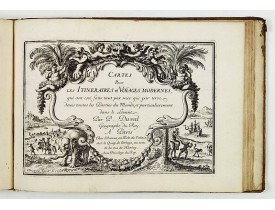
¤ Second part : Allegorical title page, dated 1698. printed title, 9pp. Letterpress with engraved coastal profiles. 44 charts. Third part : Allegorical title page (1700) with priviledge on verso, 94 pp. letterpress with engraved coastal profiles and 20 charts. Part three and four of this important maritime atlas covering the coasts from the Netherlands, Belgium, France, England, Mediteranean islands, and North Africa. Published by the official map maker of the V.O.C. During the period 1726-1755, when Johannes van Keulen II was in charge as Hydrographer of the V.O.C. he published atlas and maps to be used on board of the V.O.C. ships.
French text edition in total 64 charts prepared by Johannes Vooght. The text translated into French by Pierre Sylvestre. The charts in good and dark impressions, each with decorative cartouches. The engraved frontispiece of part 3 with allegorical figure of Holland, with traders in the Indies on the left and the figures of Mercury and Neptune examining a compass on the right. Underneath a galleon battles three galleys. Koeman, Atlantes Neerlandici,IV, Keu 83 A et Keu 103 A.
|
|
|
|
| |
14 ROUX, J. Receuil Des Principaux Plans des Ports et Rades de la Mer Mediterranée. . . Marseille, 1764. Uncoloured. Oblong 8vo. Full calf, enraved title, 170 charts all dark impressions on fine thick paper and 2pp. index. Binding used. 180 x 230 mm. Inquire about item N°33183 .
| |
5000 €
| | |
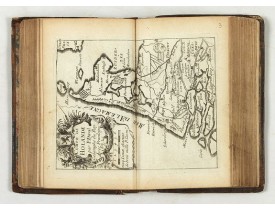
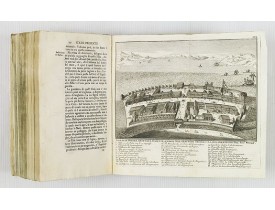
¤ A good copy of the most extended edition with 170 (rather than 65 charts) this practical pilot book, clearly intended for use on shipboard. Containing 65 sea charts on heavy paper in black and white. Paper is crisp and impressions are very sharp. Charming charts of ports along the Mediterranean coast. Including fine harbour plans of Algiers, Alicante, Barcelona, Cadiz, Gibraltar, Malaga, Marseilles, Naples, Oran, Palermo, Tangier, Toulon, Tripoli, Tunis, etc. The various issues had different numbers of plates. Joseph Rouch had a chart-publishing and selling business in Marseilles during the middle and latter part of the 18th century. The atlas contains a nicely engraved advertisement of the publisher on the inside cover.
The chart book contains the following charts : Baye et rade de Cadis, Baye de Gibraltar, Baye de Malaga, Baye de Almerie, [Coasts near Cartagena], [Coast near Alicante], [Harbor of Ibiza], [Coast near Palma de Maiorca], Baye d'Alcudia [with] Baye de Poyance, Plan du Port Mahon sur l'Isle Minorque, Baye de Sofa, Barcelone,
[Coast on the island Medes with Cap de Rose], Capdequie en Catalogne, Port Vendre en Roussillon, Roussillon,
Etang de St. Martin, Cette, Bouc, Rade de Marseille, La Ciotat, Rade du Brusc, Toulon, Plan de la rade d'Engien, Baye d'Hieres, Plan de Ste. Marguerite, [Bay of Villefranche], Génes, Especia, Livourne, Golfe de Ferraro, Plan de Civitavechia, Ville et baye de Gayétte, Golfe de Naples, Plan de la Baye de Calvi sur l'Isle de Corse, Plan de Porto Vecchio,
Carte des Bouches de Boniface, Golfe de Palme, Baye de Cagliari, Messine, Plane de Melazzo, Palerme, Trapano, Sorgente, Saragosa, Agusta, Baye de Tanger, Baye de Marzaquivir, Arzeou ou Arzeni, Baye de Tanger, Port Genevés, Golfe de Tunis, [coast of Monestier], [coasyts of Facs], Tripoli, Plan du Port de Malte, Port de Tarante, Port de Galipoli, Plan du Port et ville de Brindisi, I.St. Nicolas [and] Isle St. Domino, La Ville de Anconne, [coasts around Fort de la Volana and Point de la Panpose, Chiozza, Venise, Plan du Port de Trieste, Plan du Port Parenso, Canal de Farisina, Port St. George sur l'Isle de Lissa, Spalato, Dalmatie, I. Corfou, Carte du mouillage de Corfou, Carte des isles S.te Maure, I: Cefalunia, [Island of Zante and Castel Tornese], Ville et Port de Zante, Plan de la rade de Navarin, I. de Sapience, Morée, Port. St. Nicolo sur l'isle Serigo, Plan du Port et mouillage de Naples de Romanie, Isle de l'Especy, Isle Poro, Port Lion autrefois Port d'Athenes,
Plan de la Mandry, I:Milo, Plan du Port de Cherse, Plan du Port de Zea sur l'Isle de ce nom, Plan du port Zira, Port Paros,
Plan du Port Nio sur l'Isle de ce nom, Plan du port des Trois Bouches sur l'Isle saint Georges d'Esquiro, Plan du Port de Chatte, Golphe du Vollo, Golphe de Cassandre, Entrée du Canal de Constantinople, Canal de Constantinople , Port S. Antoine sur l'isle de Lemnos, Plan du Port Sigre sur l'Isle Metelin, I.Metelin Port Olivier, Golfe de St. Drely, Plan de la rade de Follery, Golfe de Smirne, I.Scio, Isle Ipsera [and] Antipsera, Plan du Port Siagi, Isle Estampalie, Plan de l'Isle Spine Longue sur l'Isle Candie, La Sude, Isle Garbugi, Limasol, Ernica [and] famagouste, [Charts of Sirie with: ] Alexandretta, Tripoli, Barut, Plan de la Rade de Sour, Golfe de Caiffe, Alexandrie, Barbarie la Bombe C. Razatin, St.Amansa [on Corsica], Golfe de Valincou ou de Campomoro, Bastia, Golfe et rade d'Ajacio, Naples de Malvasie, Port de la Cavale et l'isle de Tasse, Golfe de Stanchio, Port vitulo dans le Golfe de Calamata, Port Mastic sur L'isle de Scio, Port de Serfanto, Pt. du cap Creou, Isle et port Pelerizi, Pt. du Petes [with] Pt.Boudron, Port du Lago, Pt. de L'Ero dans L'Archi., Pt. de St. Jean de Patinos, Rade de Payocastro au R.me de Candie, Marmara au N E. di Rhode, Rade du Miconi, Port de Schiato, Port de Parisi, Divers ports sur L'Isle, Isle Nacry, Port de Nauce sur L'Isle Paros, Petite Isle Fourny, Port de Psara, Port de Piscopi, Port Platti sur L'Isle de Lemnos, Isles Selidroni, Golfe de Saros, Port de Carmino, Port Vaty sur Lisle Samos, Port St. Ange au Sud de L'Isle de Simi, Port de Rhode, Pt. de Scala Nova, Natolie Carlabarda, Golfe de Mandaya, Petit Bocas de Samos, Port de Chichimé, Port Gabriel L'Isle de Andre, Port St.Anne de Morgo, Island de Cacomo, Golfe de la Macra en Caramanie, Caramanie, Port Chevalier en Caramanie, Caramanie, Pt. Caragachi en Caramanie, Bengasi, Rade de Mogodor.
|
|
|
|
| |
15 d'ANVILLE (Jean Baptiste Bourguignon Atlas. Paris, 1732- 1779. In original o/l colours. Atlas in elephant folio (book block measuring 580x375 mm.), bound in modern. half calf with gilted label on spine "ATLAS DE D'ANVILLE", 59 pages multisheet maps, actual map sheet count is 42. Maps dated 1743-1786. This set is accompanied by a 4 pages printed broadsheet "Mémoire instructif. . . En Mars MDCCXXXII D'Anville, Geographe ordinaire du Roy. Permis d'imprimer ce 21 Mars 1732, Herault" and 4 pages manuscript text in pen and brown ink "Mémoire instructif pour faire la carte (de d'Anville)…"
Very good condition inside the book block, the two sheet map of Africa has slight overall browning, the others printed on fine white thick paper and coloured in outline. 580 x 375 mm. Inquire about item N°25100 .
| |
15000 €
| | |
Jean Baptiste Bourguignon d'Anville was perhaps the most important and prolific cartographer of the 18th century. He engraved his first map at the age of fifteen and produced many maps of high quality throughout his career. He became the finest cartographer of his time and carried on the French school of cartography developed by the Sanson and the de L'Isle families. Although he apparently never left the city of Paris, he had access to the reports and maps of French explorers, traders, and missionaries. During his long career he accumulated a large collection of cartographic materials that has been preserved. He was particularly interested in Asia and produced the first reasonably accurate map of China in 1735. He became Royal Geographer and Cartographer to the King of France in the middle of the eighteenth century, at a time when French cartography was still considered to be the best in the world. He was the successor to Guillaume Delisle as the chief proponent of scientific cartography, and his influence on his contemporaries was profound.
To illustrate the cartography of the middle to latter part of the eighteenth century a d'Anville map is essential. He was foremost in using the latest and most accurate cartographic information available. From the latest discoveries of the many French explorers to information available from explorers such as Cook and others. And unlike many cartographers of the day, he was not adverse to leave blank spaces in his
maps, where knowledge was insufficient.
R.V. Tooley write : "D'Anville was the finest cartographer of his time, his attention to detail was exemplary, his maps having a great delicacy of engraving". Thomas Basset and Philip Porter write: "It was because of D'Anville's resolve to depict only those features which could be proven to be true that his maps are often said to represent a scientific reformation in cartography." (The Journal of African History, Vol. 32, No. 3 (1991), pp. 367-413). D'Anville and Thomas Jefferson D'Anville's maps draw on material gathered from several French expeditions made during the first half of the eighteenth century. At this time the French were intent on finding a trade route to the western Indians and to Santa Fe and also on preempting Spanish expansion into the Mississippi river valleys. Around 1720, Jean Baptiste Bénard de La Harpe undertook two expeditions to explore the Red and Arkansas rivers and part of what is now Oklahoma. At roughly the same time, Claude-Charles du Tisné journeyed by land to the source of the Osage River and explored southeastern Kansas. Maps engraved by d'Anville incorporated the discoveries of La Harpe and Tisné and significantly improved the geographic knowledge of the Mississippi and Missouri river regions.
It is known that Thomas Jefferson acquired seven maps by d'Anville in 1787, and although the titles of the maps he acquired are not known, Jefferson must have been familiar with d'Anville's maps of North America, including "Carte de la Louisiane." In a letter to Secretary of the Treasury Albert Gallatin relating to a newly commissioned map of North America, Jefferson discussed the use of d'Anville as a reference for the lower Mississippi basin. Meriwether Lewis obtained a copy prior to the Lewis & Clark Expedition.
D'Anville's map "Carte de la Louisiane." shows the Gulf Coast from the Tallahassee area to around the mouth of the Sabine in Texas, one of the best obtainable large format maps of the region from this period. The map tracks the Mississippi, Arkansas, Red, Osage and Missouri Rivers, and includes excellent large inset of the Mississippi River Valley from the Arkansas to above the Missouri Rivers.
Most of the information was derived from Valentin Devin, who arrived in Pensacola in 1719 (under the auspices of John Law's Company of the West) and began producing highly regarded maps immediately upon his arrival on the Gulf Coast, until expelled by the Spanish after a three year struggle. Devin used his information and materials gathered from Le Maire and others to produce a number of manuscript maps which were sent back to France and resulted in a series of maps by De L'Isle, Buache and finally d'Anville, whose maps of the Gulf Coast formed the standard for a number of years.
D'Anville's two-sheet map "Amerique Septentrionale. Publiee sous les auspices de Monseigneur le Duc d'Orleans, Premier Prince du
Sang. Par le Sr. d'Anville, M DCC XLVI" depicts a "Grande Rivière" running to the west out of the "Lac des Bois" with a note that it was discovered by an Indian named Ochagac, or Ochagach, a reference to the accounts of La Vérendrye and his sons. The map labels the upper Missouri the "Pekitanoui R." Only the upper half of "Amérique Septentrionale" is exhibited. Shows boundaries of Treaty of 1763 and Ft. Duquesne.
References : Wagner, 552; Lowery, 382; Taliaferro, 134; Checklist of printed maps of the Middle West to 1900, 1-0598; Karpinski, LVIII; Tooley, Printed maps of America, 104; cf P571, 572, 599; NMM 200.
China and Korea
Jean Baptiste Bourguignon d’Anville beautifully printed and splendidly illustrated "Nouvel atlas de la Chine, de la Tartarie chinoise, et du Thibet." is the summation of European knowledge on China in the 18th-century. It was begun by the Jesuit missionaries to China in 1708, and their completed manuscripts were presented to the Emperor Kang-hi in 1718. Kang-hi ordered further surveys and from them were constructed the well-known maps forwarded to father Du Halde and used by d'Anville for this Du Haldes "Description … de l'empire de la Chine et de la Tartarie chinoise" (1736) and his Atlas (1737). This atlas contains a very detailed two-sheet map of the Far East (map 22 and 22a) including China, Korea and Japan. The map is dated 1752 and it becomes clear that he has incorporated the sources for of his "Nouvel atlas de la Chine".
Atlas in elephant folio (book block measuring 580x375 mm.), bound in contemp. half calf with gilted label on spine "ATLAS DE D'ANVILLE", 59 pages multisheet maps, actual map sheet count is 42. Maps dated 1743-1786. This set is accompanied by a 4 pages printed broadsheet "Mémoire instructif. . . En Mars MDCCXXXII D'Anville, Geographe ordinaire du Roy. Permis d'imprimer ce 21 Mars 1732, Herault" and 4 pages manuscript text in pen and brown ink "Mémoire instructif pour faire la carte (de d'Anville)..." Very good condition inside the
book block, the two sheet map of Africa has slight overall browning, the others printed on fine white thick paper and coloured in outline. Damaged spine, needs restoration.
The maps are copper engravings with original out line colour, most are double page, some folding, multi sheet maps. The first 39 maps have a number 1-39 in brown ink in a contemporary hand on verso. The cartouches on many of the maps are designed by his brother; Hubert-François Bourguignon, commonly known as Gravelot (26 March 1699 — 20 April 1773). Gravelot was a engraver, a famous book illustrator, designer and drawing-master. Born in Paris, he emigrated to London in 1732, where he quickly became a central figure in the introduction of the Rococo style in British design, which was disseminated from London in this period, through the media of book illustrations and engraved designs as well as by the examples of luxury goods in the "French taste" brought down from London to provincial towns and country houses. The maps are engraved by the master engravers Guillaume De la Haye, Major, Delafosse.
Most of d'Anville's atlases were made up for the individual customer, so it appears that no two are alike. The atlas contains the following maps, extra maps, broad sheet and manuscript note:
Ancient world :
1. - Orbis veteribus notus.
2. - Orbis romani pars occidentalis.
3. - Orbis romani pars orientalis.
4. - Gallia antiqua.
5. - Tabula Italiæ antiquæ geographica.
6. - Græciæ antiquæ specimen geographicum.
7. - Asiæ, quæ vulgo minor dicitur, et Syriæ tabula geographica. (with minor spotting)
8. - La Palestine.
9. - Ad antiquam Indiæ geographiam tabula.
10. - Ægyptus antiqua.
Europe / World map :
11. - Germanie, France, Italie, Espagne, Isles britanniques dans un âge intermédiaire de l'ancienne géographie et de la moderne.
12. - Hémisphère oriental ou de l'Ancien Monde. Revu et augmenté des découvertes, en 1786 par M.Barbié du Bocage.
With many updates in Australia.
13. - Hémisphère occidental ou du Nouveau Monde. Revu et augmenté des découvertes, en 1786 par M.Barbié du Bocage.
With many updates in USA.
 Jean Denis Barbie Du Bocage (1760-1825)
Studied at the Mazarin College in Paris and became in 1777 the only pupil of Jean-Baptiste Bourguignon d'Anville. In 1780, aged 20, he worked for the French Ministry of Foreign Affairs and, from 1785 he worked for the library of "Cabinet des médailles de la Bibliothèque du roi " and moved in 1792 to the Geography department in the same part of the same library. Since 1797 a member of "du conseil de géographie du bureau du cadastre du ministère de l'intérieur" and in 1802 he was responsible of various geographical works, among a map of the Morea (Peloponnese) for the Ministry of War. From 1803 to 1809, he was a geographer at the Ministry of Foreign Affairs and became the first professor of geography at the Faculty of Arts of Paris from 1809 to 1825. He gathered a large collection of maps and geographic documents, his library was sold after his death in February 1850.
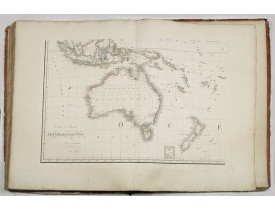
Being a pupil of d'Anville, it was clear that Jean Denis Barbie Du Bocage was asked to update the d'Anville maps after the Treaty of Paris (1783). The very large two-sheet double hemisphere world map (over 3ft, 1m) who was engraved by Guillaume Nicolas Delahaye in 1761 is heavenly updated to 1786. The states of quot;Virginie", "Caroline" are removed and replaced by "ETATS-UNIS". Alaska, Cape Cod, Savanah, S.Paul and the discoveries of Captain Cook, including an early appearance of the Sandwich Islands (Hawaii) are now added to the plate. The latest discoveries by Cook in NW of America are also included. Bocage has included nearly all Cooks detail of New Zealand. In the western hemisphere, especially Australia has many place names added. 14. - Première partie de la carte d'Europe contenant la France, l'Alemagne, l'Italie, l'Espagne & les isles britanniqs (2-sheet map of Europe, to be joined with 14a). 14a. - [Première partie de la carte d'Europe contenant la France…] (To be joined with map 14).
15. - Seconde partie de la carte d'Europe contenant le Danemark et la Norwège, la Suède et la Russie. (2-sheet map of Russia and Scandinavia to be joined with 15a).
15a. - [Seconde partie de la carte d'Europe contenant le Danemark…] (To be joined with map 15).
16. - Troisième partie de la carte d'Europe contenant le Midi de la Russie, la Pologne et la Hongrie, la Turquie. (2-sheet map of Central Europe and Turkey, to be joined with 16a).
16a. - [Troisième partie de la carte d'Europe…] (To be joined with map 16).
17. - La France divisée en provinces et en généralités.
18. - La France divisée en provinces et en généralités.
19. - L'Italie… (2-sheet map of Italy).
19a. - [L'Italie… ] (To be joined with map 19).
20. - Les Côtes de la Grèce et l'archipel.
Asia :
21. - Première partie de la carte d'Asie contenant la Turquie, l'Arabie, la Perse, l'Inde en deça du Gange et de la Tartarie (2-sheet map of Near East, to be joined with 21a).
21a. - [Première partie de la carte d'Asie…] (To be joined with map 21).
22. - Seconde partie de la carte d'Asie contenant la Chine et partie de la Tartarie, l'Inde au-delà du Gange, les Isles Sumatra, Java, Bornéo, Moluques,
Philippines, et du Japon (2-sheet map of the Far East, to be joined with 22a).
22a. - [Seconde partie de la carte d'Asie…] (To be joined with 22, Showing China, Korea and Japan).
23. - Troisième partie de la carte d'Asie, contenant la Sibérie, et quelques autres parties de la Tartarie (2-sheet map of Russia and Siberia, to be joined with 23a).
23a. - [Troisième partie de la carte d'Asie,..] (To be joined with 23. Showing Siberia and Kamchatka and northern tip of Japan).
24. - Carte de l'Inde dressée pour la Compagnie des Indes (4-sheet map of India and Siam. Two joined sheets of northern India, to be joined with 24a).
24a. - [Carte de l'Inde …] (2 joined steets, to be joined with map 24.).
25. - Coromandel (2-sheet map of Coromandel coast, to be joined with map 25a).
25a. - Coromandel. (to bejoined with map 25).
26. - Golfe persique.
27. - Essai d'une nouvelle carte de la mer Caspienne.
28. - Carte de la Phœnicie et des environs de Damas.
29. - L'Euphrate et le Tigre.
30. - Golfe Arabique ou mer Rouge. Africa :
31. - Afrique (4-sheet map of Africa, 2 joined sheets).
31a. - [Afrique] (2 joined sheets with map 31.)
32. - Égypte nommée dans le pays Missir.
33. - Carte particulière de la côte occidentale de l'Afrique depuis le cap Blanc usqu'au cap de Verga, et du cours des rivières de Sénéga et de Gambie […] dressée pour la Compagnie des Indes (2-sheet map, to be joined with 33a).
33a.
- [Carte particulière de la côte occidentale de l'Afrique… ] (to be joined with map 33).
34. - Guinée entre Sierre-Lione et le passage de la ligne.
America :
35. - Amérique septentrionale (4-sheet map of North America, 2 joined sheets).
35a. -[ Amérique septentrionale] (2 joined sheets with map 35.)
36. - Canada, Louisiane et terres angloises (4-Sheet map of Canada and New England, to be joined with 36a, 36b, 37).
36a. - [Canada, Louisiane et terres angloises]
36b. - [Canada, Louisiane et terres angloises]
37. - Le Fleuve Saint-Laurent.
38. - Carte de la Louisiane (2 joined sheets).
39. - Amérique méridionale ( 6-sheet map of South America, 2 joined sheets).
39a. - [Amérique méridionale] (2 joined sheets with 39 and 39b).
39b. - [Amérique méridionale] (2 joined sheets with 39 and 39a).
Bound with :
(40) - Printed letter press by d'Anville, Mémoire instructif pour que dans toutes les paroisses d'un diocèse, il soit
dressé en même-tems & uniformément, par une méthode aisée à pratiquer, des cartes & des
mémoires particuliers, qui puissent fournir un détail suffisant pour la carte générale de ce diocèse
ou d'une province. A Paris, chez Louis-Denis Delatour, 1732. 4 pp. in-folio.
(41) - Anonymous manuscript in brown ink : Mémoire instructif pour faire la carte (de d'Anville). No date. 4 pp. in-4.
Detailed description about how to draw a map.
(42) - Double page circulair projection with orientations and topographical icons and signs.
(43) - Carte topographique du diocèse de Lizieux.
(44) - Position des points discutés dans l'analyse géographique de l'Italie par le sr d'Anville.
(45) - Parallèle du contour de l'Italie selon les cartes de MM. De l'Isle et Sanson, et celle qui résulte de l'Analyse géographique de
ce continent par le s. d'Anville.
|
|