Optical prints
Optical prints
By Kees Kaldenbach. More info about the author.
The Peep show box - Optical prints in Japan - China


Little has been published (particularly in English) on the type of print known as the perspective view, intended for use in an optical diagonal machine. Nevertheless, these prints were highly popular in the eighteenth and nineteenth centuries and still appear regularly on the art market. lt, therefore, seems worth collecting what information is known and adding what I have been able to discover. 1 This article opens with a discussion of the various types of optical diagonal machine and how they function. This is followed by a brief sketch, based on material taken from eighteenth- and nineteenth-century catalogues and household inventories, of the social classes who owned them.The final section is devoted to an examination of the different characteristics of the perspective views produced in the four main centres, London, Paris, Augsburg and Bassano: particular attention is paid here to two draughtsmen who worked for publishers in Augsburg.
 The optical
diagonal machine (zograscope)
The optical
diagonal machine (zograscope)
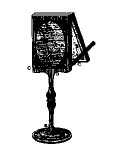 The optical diagonal
machine 2 is a viewing apparatus whose main
components are a large, double convex lens and a mirror fixed
directly behind it at an angle. These are attached either on top of
a pyramid-shaped box or on top of a stand. When the spectator looks
at perspective views through the lens of the viewing machine, an
illusion of recession is produced. In principle, a similar illusion
of distance can be achieved simply by using a single, detached
convex lens which is larger than the distance between two human
eyes (at least ten centimetres). When this lens is held just in
front of the eyes, the spectator is looking at the perspective view
through its two edges which function like two prisms. Light rays
bouncing off the print are refracted in such a way that they enter
the eyes in a parallel direction. The brain interprets the incoming
parallel images as a single image seen from a great distance. The
important function of the lens in the optical machine is not its
magnification but its creation of an illusion of depth in binocular
vision.
The optical diagonal
machine 2 is a viewing apparatus whose main
components are a large, double convex lens and a mirror fixed
directly behind it at an angle. These are attached either on top of
a pyramid-shaped box or on top of a stand. When the spectator looks
at perspective views through the lens of the viewing machine, an
illusion of recession is produced. In principle, a similar illusion
of distance can be achieved simply by using a single, detached
convex lens which is larger than the distance between two human
eyes (at least ten centimetres). When this lens is held just in
front of the eyes, the spectator is looking at the perspective view
through its two edges which function like two prisms. Light rays
bouncing off the print are refracted in such a way that they enter
the eyes in a parallel direction. The brain interprets the incoming
parallel images as a single image seen from a great distance. The
important function of the lens in the optical machine is not its
magnification but its creation of an illusion of depth in binocular
vision.
So that the greatest illusion of recession can be achieved, the
perspective view should be designed according to strict principles
of linear perspective, with a distant object placed in the centre
of the print. For example, a view looking down a receding street
works well because all horizontal lines in the buildings appear as
lines converging at the same vanishing point. The interior of a
large building, such as a cathedral, is also suitable for creating
a successful illusion of depth (fig. 37). The least effective point
of view is perpendicular to a facade, such as a row of houses, or
to the front of a palace, because from that viewpoint there is no
effect of perspective. In any case, the angle of vision for any
perspective view should be wider than the angle of forty-six
degrees which corresponds to the human eye's normal range of
vision. This explains why perspective views have an appearance
similar to a photograph taken with a wide-angle lens. Of course,
perspective views are not the only images which can be used with
the optical machine: any two-dimensional image, such as a painting
or a mural, would be suitable. However, the illusion of recession
the latter would give to the spectator would depend on the
emphasis on linear perspective their images had.
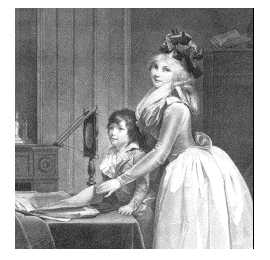 The most basic and, at the
same time, effective model of a viewing machine is the table model
on a stand whose lens is at eye level when the viewer is seated. In
figure 36 the woman, Louise-Sebastienne
Gély (later to marry Danton) is showing a perspective view
to a boy (probably Antoine, Danton's
eldest son). So as to avoid any distortion which might be caused
through the print curling if it were held manually, this model of
the optical machine incorporates a mirror, fitted at an angle
directly behind the lens which thus permits the prints to be viewed
lying on a flat surface. The function of the mirror is simply to
get around the problem of curling; it plays no part in creating the
illusion of depth. Nevertheless, it has the consequence that the
image is seen upside down and reversed. For this reason, many views
have the text not only at the bottom of the print in the normal
direction but also at the top, in reverse (and often in large
capitals) so that it can be read when viewed through the optical
machine. Some views, but not all, were also executed in mirror
image so that they would be seen in the right direction through the
viewing apparatus (see fig- 38, for example). This of course is
simple for the engraver who does not have to worry about problems
of reversal when engraving the plate.
The most basic and, at the
same time, effective model of a viewing machine is the table model
on a stand whose lens is at eye level when the viewer is seated. In
figure 36 the woman, Louise-Sebastienne
Gély (later to marry Danton) is showing a perspective view
to a boy (probably Antoine, Danton's
eldest son). So as to avoid any distortion which might be caused
through the print curling if it were held manually, this model of
the optical machine incorporates a mirror, fitted at an angle
directly behind the lens which thus permits the prints to be viewed
lying on a flat surface. The function of the mirror is simply to
get around the problem of curling; it plays no part in creating the
illusion of depth. Nevertheless, it has the consequence that the
image is seen upside down and reversed. For this reason, many views
have the text not only at the bottom of the print in the normal
direction but also at the top, in reverse (and often in large
capitals) so that it can be read when viewed through the optical
machine. Some views, but not all, were also executed in mirror
image so that they would be seen in the right direction through the
viewing apparatus (see fig- 38, for example). This of course is
simple for the engraver who does not have to worry about problems
of reversal when engraving the plate.
Perspective prints (optical prints)
Perspective views were produced from the early eighteenth century to the beginning of the nineteenth, the greatest number of them probably between c. 1740-1790.3
lt is difficult to give them a precise definition because of
their many variations, but there are a number of common
characteristics.
Firstly, they are usually etched and invariably designed to be seen
through a viewing machine, with consequent reversals of text and
image. The size of the image is about 23 by 40 centimetres and the
entire plate, with text, about 30 by 45 centimetres: sizes vary by
5 to 10 centimetres at the most. Perspective views are always
horizontal in format since the subject-matter is usually
topographical. They often show monumental buildings (palaces,
churches or town halls) or characteristic parts of towns (gates,
squares, streets or harbours for example). More rarely they show
portraits, depict moralistic or biblical themes, or historical
events such as the demolition of the Bastille or the ascent of
hot-air balloons, to name two of the more popular.
The etcher would usually work after existing prints, less often after specially-prepared drawings and more rarely still after paintings; the plates were probably etched in the workshops of the publisher. lt is likely that the publisher controlled the whole operation, although there is no evidence that the printing and hand-colouring were done in the same workshop. All these perspective views have a strong common factor in the nature of their execution. The etcher paid special attention to the straight lines in architecture and accentuated horizontal lines in buildings to enhance the perspective. At the same time, he paid little attention to surface detail or texture, or to the contrast between light and shade. lt is often impossible in these prints to determine the material of which a building has been constructed - brick, stone or stucco, for example - although to some extent this difficulty is overcome by the use of hand-colouring. The care is taken in this, however, was only noticeable in views produced in London. In general, one can say that the quality of colouring in perspective views is superior to that found on popular woodcuts of the time, although nowhere near the standard reached in prints designed as works of art. Perspective views served a different purpose from artistic prints. The viewer could make a voyage imaginaire for his own instruction and pleasure. By selecting a certain series of views, he could make a 'journey' (possibly together with others) through cities either known or unknown to him. The prime concern was whether the image was recognizable; its artistic quality was less relevant. The stylistic changes of the period do not appear to have held any influence over the etchers. The contemporary authors speak of the importance of obtaining an illusion of reality: for example, Johan Bischoff states in 1764 that
- "one should cover the flat mirror so much until one sees through the lens neither the edge of the painting [print] nor anything outside the edge, but only the painting almost entirely ... In opticas in which one cannot cover the mirror one can help by blackening the edges of the image."
Names for the viewing machines and perspective prints
Names for the viewing machines and perspective prints vary more in Britain than on the continent. Catalogues produced by British print publishers of the eighteenth and nineteenth centuries give a number of alternative titles. In his catalogue of 1717 Henry Overton I calls them 'prospects', a term also used in the 1731 John Bowies catalogue: 'Prospects neatly graved each on one large Sheet of Paper'. If the Henry Overton II catalogue of 1754 merely mentions 'Views, each on One Sheet of Large Paper', a much fuller description appears in the Carington Bowles catalogue Of 1784:
'Sets of fine prints. Perspective views. The following Sets consists of a large Variety of perspective Views, containing remarkabie Views of Shipping, eminent Cities, Towns, Royal Palaces, Noblemen and Gentiemans Seats and Gardens in Great Britain, France and Holland, Views of Venice, Florence, Ancient and Modern Rome, and the most striking public Buildings in and about London.'
- The next sentence explains their dual-use:
- 'Esteemed not only for Furniture but are likewise much used,
properly coloured, without Frames, for Viewing in the Diagonal
Mirrours, or Optical Pillar Machines, in which Method of looking at
them, they appear with surprising Beauty, and magnify almost to the
size of the real Building; any of them may be had separate. Price
is. plain, or 2s. each coloured'.
Meanwhile, the Laurie and Whittie catalogue of 1795 speaks of
- 'Perspective views ... for the Diagonal Mirror; or Optical Machine ... All the preceding Views ... are kept ready Coloured for the Show Glass at 2s. each.'
Similarly, Robert Laurie's 1824 catalogue lists: 'Perspective views, coloured for the Show Glass or Diagonal
Mirror . . .' It was probably the scientific
instrument-maker George Adams who coined the term 'Zograscope' to replace all these cumbrous
expressions, but the name did not catch on. On the continent, names
for the viewing machines and perspective prints were less diverse.
In France, where the viewing machine was believed to have
originated, the prints were called 'vue
d'optique' or 'vue
perspective', and the apparatus itself simply
'optique' or 'boîte d'optique'. In Germany, the views
were known as 'Guckkastenbild'
or 'Guckkastenblatt'
(literally'looking-box-sheet'), while the optical machine was
called 'Guckkasten'. Meanwhile
in ltaly 'Realetti Prospettive'
were viewed in 'Camere
Ottiche', whilst in Holland an 'opticaprent' was looked at in an
'optica '.
Various models of the viewing machine
Various models of the
viewing machine are known. The Rijksmuseum, for example, boasts
two. The first model consists of a lens with a mirror placed at an
angle directly behind it and is held in a simple wooden frame,
supported by a wooden pillar (similar models are shown in figs. 36
and 43). The Science Museum in London has a comparable model, made
by the scientific instrument-maker Edward Nairne of the firm Nairne
& Blunt, whose premises were at 'No. 20, Opposite the Royal
Exchange, Cornhill, London'. This is a more sophisticated machine,
with a balancing system for both the lens and the mirror, while the
top section can be raised and lowered into the pillar. lt is 66
centimetres in height has a lens of 11 centimetres in diameter,
and also an ornamental frame.5
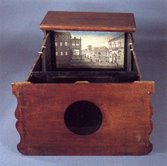
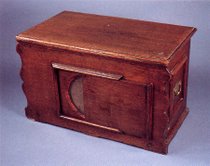
The second viewing machine in the Rijkmuseum donated in 1980 by Lady C.J. Six (together with a collection of perspective views) is a wooden, four-sided, pyramid-shaped model, about 70 centimetres high (see fig. 39). lt has three closed sides and one open side, the latter bearing a row of candle holders which permit the prints to be viewed by candlelight as well as daylight. This model can be ingeniously folded up into the book-shaped box which constitutes its base. On the spine, the book title reads PERSPECTIVE VIEWS, in English.

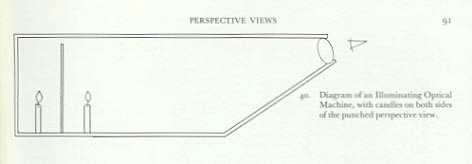
Cut out or illuminating optica
 A horizontal variation of this standing,
pyramid-shaped model is the 'illuminating optica', which has a lens
but no mirror (fig. 40). Views for this type of apparatus had to be
specially prepared. The print was first glued on to stiff card, and
holes were cut out of those sections where the building had
windows, whilst punch marks served to indicate where Chinese
lanterns and festoons might hang. On the back of these windows and
holes, coloured paper was glued - often bright red and oiled. In
front of and behind the view candles were lit, giving to the whole
a magical and otherworldly quality. The Theatre Museum in Amsterdam
displays such an 'illuminating optica'. lt has an unusual lens,
ground out of a square piece of glass, which gives a lesser
illusion of depth than the two models in the Rijkmuseum.6
A horizontal variation of this standing,
pyramid-shaped model is the 'illuminating optica', which has a lens
but no mirror (fig. 40). Views for this type of apparatus had to be
specially prepared. The print was first glued on to stiff card, and
holes were cut out of those sections where the building had
windows, whilst punch marks served to indicate where Chinese
lanterns and festoons might hang. On the back of these windows and
holes, coloured paper was glued - often bright red and oiled. In
front of and behind the view candles were lit, giving to the whole
a magical and otherworldly quality. The Theatre Museum in Amsterdam
displays such an 'illuminating optica'. lt has an unusual lens,
ground out of a square piece of glass, which gives a lesser
illusion of depth than the two models in the Rijkmuseum.6
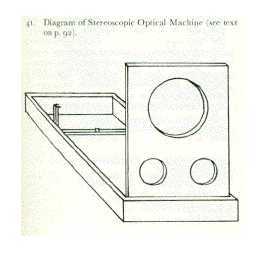
 Around 1850 the
stereoscope, and the accompanying double 'stereo' photographs,
appeared on the market. This instrument produced an illusion of
depth greatly superior to that of the standard viewing machine. In
the period of transition between the viewing machine and the
stereoscope, another simple apparatus had been invented which was suitable for viewing both perspective views and stereoscopic
photographs. This consisted of a vertical panel, about 35
centimetres high (fig- 41) on the upper part of which was fitted
one large lens, and on the lower part two smaller ones, behind
which the stereoscopic photographs could be placed, in a small
frame. The panel was hinged at the bottom to a box, which was
somewhat larger than the panel itself.7
Around 1850 the
stereoscope, and the accompanying double 'stereo' photographs,
appeared on the market. This instrument produced an illusion of
depth greatly superior to that of the standard viewing machine. In
the period of transition between the viewing machine and the
stereoscope, another simple apparatus had been invented which was suitable for viewing both perspective views and stereoscopic
photographs. This consisted of a vertical panel, about 35
centimetres high (fig- 41) on the upper part of which was fitted
one large lens, and on the lower part two smaller ones, behind
which the stereoscopic photographs could be placed, in a small
frame. The panel was hinged at the bottom to a box, which was
somewhat larger than the panel itself.7
 In addition to
these apparatus, other optical gadgets were available on the market
which appear to have been equally popular with collectors, as can
be seen by examining Dutch auction catalogues of the period. Take,
for example, the catalogue of the auctioneers J. Gaillard and B.
Scheurleer of The Hague, dated 16 September 1782, which describes
the estate of the physician J. Westerhoff. 11 Towards the end of this catalogue, which mainly
lists books, there is a section headed 'curiosities' which includes
a number of scientific instruments. Some of these, such as prisms
and magnifying lenses would be considered serious instruments by
the standards of the twentieth century, whilst others, such as
magic lanterns and shadow games would be judged more like toys;
others still would belong to a different category, that of
anamorphosis. Anamorphoses are images which appear unintelligible
to normal perception; only by the use of mirrors and glasses to
correct the distortion do the images appear as recognizable shapes.
The various optical instruments listed in this catalogue are
specified as follows. Item 53 mentions 'a very nice English
edge-pillar mirror of metal, very finely ground and polished, in a
tin tube, to which belongs an artful painting in oils, wide 27,
high 21 thumbs'. This 'edge-pillar'
(or in Dutch: kantzuil) maybe
defined as a cylinder having one or more flat surfaces - Item 55
goes on to describe'a very fine English cone mirror, as finely
ground as the preceding, in a tin tube', which is listed together
with two accompanying paintings. Here the spectator would view the
cone, with one eye immediately above its point, and see the
reflection of the painting on which the cone itself was positioned.
Meanwhile, item .59 describes a cylindrical mirror with a painting
which was to be looked at an angle from above, in a very similar
fashion to item 55; it is listed as 'A very nice English pyramid
mirror, as admirable as the preceding, also in a tin tube.' Item 64
was 'an Anamorphosis on a mahogany frame, together with two
facet-glasses', with which were also listed four drawings placed on
a base. Then, item 65 mentions a viewing machine: 'a very nice
mahogany illuminating box, high 24 and wide 18 thumbs, to which an
eyeglass and twelve punctured illuminating views'. Finally, a few
other items of interest can he mentioned: number 43, describing 'a
tin magic lantern with 36 movable and fixed images painted on
glass, to which a mirror and a tube to use with rays of the sun',
and also numbers 46 to 50 which list a convex, and a number of
concave mirrors. Perhaps the earliest
description of a viewing apparatus is that given by J. C.
Kohlhans in 1677 when he writes about a camera obscura used as a
viewing machine and stresses the necessity of binocular vision in
order to achieve an illusion of depth:
In addition to
these apparatus, other optical gadgets were available on the market
which appear to have been equally popular with collectors, as can
be seen by examining Dutch auction catalogues of the period. Take,
for example, the catalogue of the auctioneers J. Gaillard and B.
Scheurleer of The Hague, dated 16 September 1782, which describes
the estate of the physician J. Westerhoff. 11 Towards the end of this catalogue, which mainly
lists books, there is a section headed 'curiosities' which includes
a number of scientific instruments. Some of these, such as prisms
and magnifying lenses would be considered serious instruments by
the standards of the twentieth century, whilst others, such as
magic lanterns and shadow games would be judged more like toys;
others still would belong to a different category, that of
anamorphosis. Anamorphoses are images which appear unintelligible
to normal perception; only by the use of mirrors and glasses to
correct the distortion do the images appear as recognizable shapes.
The various optical instruments listed in this catalogue are
specified as follows. Item 53 mentions 'a very nice English
edge-pillar mirror of metal, very finely ground and polished, in a
tin tube, to which belongs an artful painting in oils, wide 27,
high 21 thumbs'. This 'edge-pillar'
(or in Dutch: kantzuil) maybe
defined as a cylinder having one or more flat surfaces - Item 55
goes on to describe'a very fine English cone mirror, as finely
ground as the preceding, in a tin tube', which is listed together
with two accompanying paintings. Here the spectator would view the
cone, with one eye immediately above its point, and see the
reflection of the painting on which the cone itself was positioned.
Meanwhile, item .59 describes a cylindrical mirror with a painting
which was to be looked at an angle from above, in a very similar
fashion to item 55; it is listed as 'A very nice English pyramid
mirror, as admirable as the preceding, also in a tin tube.' Item 64
was 'an Anamorphosis on a mahogany frame, together with two
facet-glasses', with which were also listed four drawings placed on
a base. Then, item 65 mentions a viewing machine: 'a very nice
mahogany illuminating box, high 24 and wide 18 thumbs, to which an
eyeglass and twelve punctured illuminating views'. Finally, a few
other items of interest can he mentioned: number 43, describing 'a
tin magic lantern with 36 movable and fixed images painted on
glass, to which a mirror and a tube to use with rays of the sun',
and also numbers 46 to 50 which list a convex, and a number of
concave mirrors. Perhaps the earliest
description of a viewing apparatus is that given by J. C.
Kohlhans in 1677 when he writes about a camera obscura used as a
viewing machine and stresses the necessity of binocular vision in
order to achieve an illusion of depth:
- 'On one side in the middle of a trapezium a hole is also made through which one looks into the box onto a white paper or on a cardboard made white, which is the bottom part of the box: the other parts must he all black on the inside. One can take the bottom piece or cardboard away and replace it with other objects in the box in order to see objects before the eyes. Thus the presented objects appear in Perspective, just like the painter imagines by sketching and painting. However, if one puts another convex lens into the hole for instance at about the same angle as the hole from the opposite white sheet, one sees the objects mentioned above as they appear outside to the naked eye, in width, roundness and distance; this is a new invention which can be used in the camera obscura as well ... One has to open the door of the box, which is the one side that can be removed, so that daylight may enter, to make visible the images and objects within.'9
 In 1753, the Englishman S.
Parrat described a box-shaped viewing apparatus with a lens but no
mirror (see fig. 42).10 In order to stand
upright in this machine, a perspective view had first to be glued
onto stiff card: the Rijksmuseum has a number of these prints.
Meanwhile, the concave mirror is described in early
eighteenth-century books as an instrument used to create an
illusion of depth when looking at images. For example, Ozanam
(Récréations mathématiques et physiques, Paris 1735)
describes the way a concave mirror works when placed in a 'chambre
optique'. The spectator looked through a hole in a box and saw in
the concave mirror on the opposite wall the reflection of a view
placed below the viewing hole. One can oneself put this to the test
by using an ordinary shaving mirror, which is concave and thus
magnifies. If one holds an architectural view at chest height and
then stands with the mirror at arm's length in front of one, the
resultant image has a noticeable illusion of depth, even if the
mirror has a relatively small diameter.
In 1753, the Englishman S.
Parrat described a box-shaped viewing apparatus with a lens but no
mirror (see fig. 42).10 In order to stand
upright in this machine, a perspective view had first to be glued
onto stiff card: the Rijksmuseum has a number of these prints.
Meanwhile, the concave mirror is described in early
eighteenth-century books as an instrument used to create an
illusion of depth when looking at images. For example, Ozanam
(Récréations mathématiques et physiques, Paris 1735)
describes the way a concave mirror works when placed in a 'chambre
optique'. The spectator looked through a hole in a box and saw in
the concave mirror on the opposite wall the reflection of a view
placed below the viewing hole. One can oneself put this to the test
by using an ordinary shaving mirror, which is concave and thus
magnifies. If one holds an architectural view at chest height and
then stands with the mirror at arm's length in front of one, the
resultant image has a noticeable illusion of depth, even if the
mirror has a relatively small diameter.
Another early description
and illustration of a viewing apparatus appears in the famous
Encyclopédie of 1767 by Diderot and d'Alembert. Figure 43,
taken from the Encyclopédie, shows the simple model of the
viewing machine on a pillar with a lens and a diagonally-placed
mirror. Since there are no sidewalls on this model, the amount of
light entering the machine is unlimited. Three years later Guyot,
in a sequel to Ozanam's book, 11 also
published a description of the viewing machine, together with an
illustration.
He wrote: 'the looking-box with a diagonal mirror. This type of
looking box is very well known because they are in many
hands'.
In what households ?
Little has been written about the question as to what type of household owned the viewing machine. The most useful source of information is the study by Marie van Dijk on Dutch household inventories during the first half of the nineteenth century. 12 Altogether, Van Dijk researched 3,507 inventories (probates and personal estates) in 105 municipalities in Holland and analysed them in terms of the ownership of toys and games.
She differentiated five social groups: a) farmers, b) labourers and workers paid by the day, c) those without a trade, d) tradesmen and shop- keepers, e) notables and the well-to-do. Only the latter two groups were found to own optical machines, in five cases for tradesmen and shopkeepers, and in fourteen for notables and the well-to-do. The numbers of items recorded were as follows: viewing machines (12), magic lanterns (5), concave mirrors (5), cone mirrors (2), peep-shows (2), a cylindrical mirror (1) and an illuminating optica (1), all of these apparatus being listed with accompanying views either in the form of prints or views painted on glass. One individual, an 'entrepreneur', owned several of these optical instruments.
The conclusion from van Dijk's study, then, was that these
optical apparatus were owned only by the well-to-do. In order to
meet the demands of the tax authorities, these inventories supplied
estimated values. The Dutch guilder (Hfl or Dfl.) was worth roughly
is 8d at that time. Van Dijk found that the value of viewing
machines ranged considerably, from Dfl. 3 or Dfl. 5 to as much as
Dfl. 8 (in an example where the apparatus included 100 views of the
highest quality) or even Dfl. 10 (citing two cases, one in which
the apparatus was estimated together with 60 views of the highest
quality, and the other referring to the viewing machine alone). A
magic lantern was estimated at Dfl. 7, while a cylindrical mirror
was estimated, together with a cone mirror, at Dfl. 12. Finally,
a peep-show was estimated at Dfl. 6, a price which included its
views, lamps and base.
Prices for optical prints and viewing machines
Prices in London for perspective views and viewing machines can be found out more easily. For example, most auction catalogues give the price for a perspective view; 1s. for an uncoloured print and 2s. for coloured. Only the larger and more elaborate views of Roman antiquities (see fig. 44) were considerably more expensive, costing 10s. 6d uncoloured and £ 1. 5s. coloured. A viewing machine, meanwhile, could be bought in some publisher's shops, as is apparent from the Laurie and Whittle catalogue for 1795: Diagonal Mirrors, for the shewing of these views, neatly fitted up in Mahogany, with Looking- Glass. One Guinea each'.
lt was also sold by scientific instrument-makers such as George Adams for prices varying in the year 1769 from 18 shillings to £ 2. 12. 6d., although in subsequent years (for example 1789 and 1797) the prices listed in his catalogues are more constant.
In Augsburg, perspective
views ranged in price from 1 to 2 Augsburg Florins, or about is.
8d. to 3s- 4d. at the rate of exchange in that period.13
However, prices in Paris
were much lower. An indication of wholesale prices in Paris has
recently been estimated by Pierre Casselle investigating the
probate inventory of the print publisher Laurent Pierre La
Chaussée, which was drawn up by his colleague Louis Mondhare in May
1782. 14 Casselle gives the following
prices: 328 livres tournois for a group of 138 plates (which
is 6 livres, or 5 shillings each) ; 112 livres tournois for
a stack of 2,800 perspective views in black and white, of
'demi'-fine' quality (which is less than a sou, or about one penny
each); and 6 livres tournois for 14 viewing machines, an
estimate which should probably he understood as 6 livres for them
all.
The publisher Remondini from Bassano lists in his 1772 catalogue four
perspective views for 1 lira (or five pennies) if uncoloured
and for 2 lire when coloured. By 1784, however, his prices
were about 20%. lower, with a wholsesale price of 20 lire for 100
uncoloured views, or 35 lire for 100 if coloured. Later still, in
1817, these prices dropped even further, to 12,50 and 20,50 lire
respectively.15 Remondini's prices are thus
clearly lower than those in London and Augsburg, but still higher
than the average price for a perspective view in Holland, which cost about two pennies each
according to the rate of exchange already cited.16 The latter information is derived from a collection
of late eighteenth-century Dutch sale catalogues of books and
curiosities. 17 Some thirty of these have
had the prices of the books and curiosities jotted down in the
margin, evidently by the customer or the auctioneer. These prices
are as follows: from Dfl. 1 to Dfl. 10 for a viewing machine, from
Dfl. 4 to Dfl. 36 for an illuminating optica, Dfl. 5 for
anamorphoses, from Dfl. 7 to Dfl. 32 for magic lanterns (with the
exception of one which was priced at Dfl. 112) and finally Dfl.
0,10 (or 2 pennies) for perspective views (sold in bundles of 10 or
20) and a little more, Dfl. 0,12 for illuminating views (also sold
in bundles of 10 or 20).
The evidence indicates, then, that only the well-to-do could afford perspective views and the viewing machine. 18 On an average wage of no more than one to two shillings a day, the German, British or Dutch labourer would have hardly been likely to afford such luxuries. However, the less well-off were able to become acquainted with perspective views at fairs and markets, where travelling showmen displayed their views, often with an accompanying story, for a small fee. As late as 1932 the German author Elsner von Gronow could state that 'the optica is only known to our contemporaries from the annual fair'.
Perspective views produced in London
Perspective views produced in London are generally of high quality. Publishers
were apparently prepared to invest in competent draughtsmen,
engravers, printers and colourers. They can also be distinguished
from these made in the other centres by their colouring; thus skies
are sometimes coloured in atmospheric perspective with dark blue at
the top shading towards a lighter blue on the horizon. In general,
prints produced in Londen are easy to identify in that, in
accordance with the copyright act of 1734, they carry on them the
name of the publisher and the date of publication. This, however,
may not invariably have been done, and many impressions have been
trimmed as part of the mounting operation. There are therefore
cases where certainty is not easily reached.
Most of the views produced in London are of what may be termed
the'European standard size'- about 12 by 18 inches (300 by 450 mm)
. This consistency of size would have followed the construction of
the optical machines and doubtless promoted the international
distribution of the views - and also made copying and piracy an
easy matter. The numbers of different prints produced in Londen can
now be readily reassessed by examination of these catalogues put
out by publishers of the period. Of these, six have been examined
which offer information of importance to this study. 19 They are as follows:
(a) Henry Overton I, at the White
Horse without Newgate, 1717. This contains 24 pages listing, in a
rather disorganized way, maps, 'prospects' and 'views', which may
be understood as perspective views. Of these, I counted a total of
164.
Overton's stock descended to his cousins, Henry II, or to Robert
Sayer, or to both (see below) -
(b) John Bowles at Mercer's Hall,
Cheapside, 1731 - Of the 63 pages, these on pages 28-30 list 56
perspective views, under the title 'prospects'.
(c) Robert Sayer of the Golden Buck
opposite Fetter Lane, Fleet Street, offered 202 views in 1753
(although the title-page boasts 206); a further 14 can be found in
his 1755 supplementary sheet. Sayer's stock was taken over by
Laurie & Whittle.
(d) Henry Overton II, also at the
White Horse without Newgate, listed 493 different views on pp.
23-36 of his 1754 catalogue. Typographically, it falls into two
parts; a clearly laid-out text en pp. 23-29, and a closely set text
on pp. 30-36.
(e) Carington Bowles at 69 St Paul's
Church Yard, had 267 views on pp. 70-83 of his catalogue Of 1784.
(f) Finally Laurie & Whittle of 53
Fleet Street had 231 views in 1795, listed on pp. 49-57-
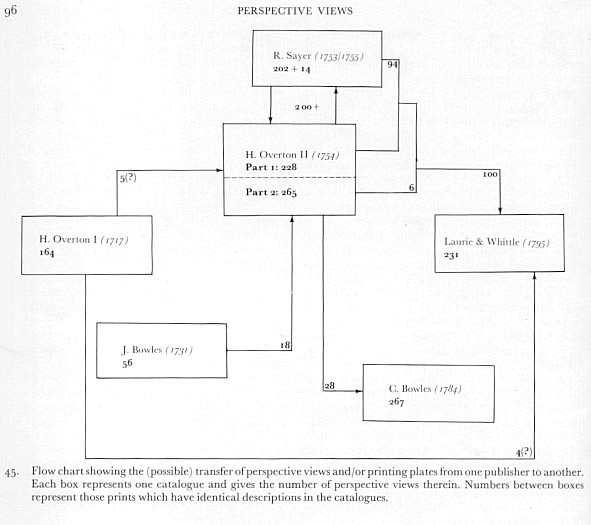
(Note: See all the way below for an addition to this chart - KK 2004)
Apart from these publishers, known through their catalogues, I have seen the names of other publishers on views in the Rijksmuseum print room. These are John Tinney, John Boydell and F. Mayor. Other prints were jointly published: combinations of names that appear are Sayer & Ardell, Overton & Sayer, Sayer & Boydell, and Sayer & Boydell & Overton. Some perspective views remained popular for many decades; others did not sell as well, and were discontinued and the printing plates sold. In order to get an idea of the total number of existing perspective views and the continuity in popularity of certain groups of views, I made a table of concordance of the titles found in these six catalogues. From this table, I compiled a 'flow chart' (fig. 45, above). In the flow chart, a closed box indicates one catalogue cach. An arrow indicates a description which is the same in the two catalogues, and the number on the arrow indicates the number of identical titles. It should be noted that identical titles might mean that the plate was the same, or it might point to a different plate - whether a copy or completely unrelated. As can be seen in the chart, there is surprisingly little similarity between the titles of perspective views in these catalogues. Similarities exist in a few places only: the 1753 Sayer catalogue is almost entirely the same as the first part of the 1754 Overton catalogue. Wording, subdivisions and typography are very similar. The C. Bowles 1784 catalogue is quite different from the Overton 1754 catalogue, except for a few scattered views. Only two groups of prints, the 'Gardens al Stow' and 'Monamy's sea pieces', have identical titles. Greater similarity exists between the Laurie and Whittie 1795 catalogue and the combination Sayer 1753 / Overton II 1754. There are 100 views with identical titles, which means that more than half of Sayer's stock has been omitted. Similarities exist in the sections London, Scotland, Ireland, Holland, Paris, and Monamy's sea pieces.
The main problem that remains to be resolved is the significance of what appear to be identical prints being offered simultaneously by different publishers. Did they own the plate jointly, or did they, as suggested by Antony Griffiths in his article on British print publishers (referred to in note 19), exchange stocks of prints from their own plates against stocks of prints from other publishers in order to spread the risk and balance their inventory? Further questions are raised by an examination of the collection of over 110 Perspective views published in London which is now in the Rijksmuseum. Many of them were given by Lady C. J. Six, who also donated the unique copy of the 1753/1755 Sayer catalogue (fig. 46). Since no fewer than 83 of the 202 prints listed in the 1753 catalogue, and 13 of the 14 included in the 1755 supplement are to be found in the Rijksmuseum, the conclusion seems highly plausible that the catalogue was actually used by the Six ancestors when placing their orders in the 1750's. No less than three versions of the Lord Mayor's mansion in London are to be found in the Amsterdam collection (figs- 47-50). They show the bewildering numbers of copies made of popular subjects and reveal the difficulties in deciding where any copy may have been made. The first is an immaculate, carefully coloured print (fig. 47) with blue skies, white clouds and a pale horizon, the buildings and street a reddish-brown, sand colour and light brown, and many bright colours in the clothing of the people and the carriages. The caption reads:
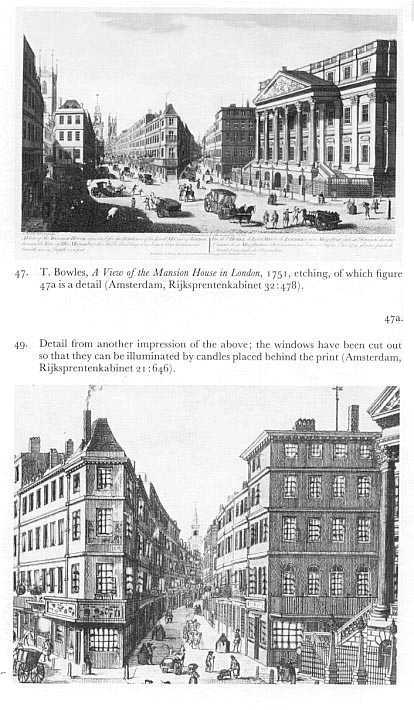 A view of the MANSION
HOUSE appointed for the Residence of the Lord mayor of LONDON during
the year of his Mayorality this noble Building was begun 1739
Contains in breath 100 in Depth 220 feet. Printed for & Sold by
Rob Sayer at the Golden Buck opposite Fetter lane Fleet street. T.
Bowles delin et sculp.
A view of the MANSION
HOUSE appointed for the Residence of the Lord mayor of LONDON during
the year of his Mayorality this noble Building was begun 1739
Contains in breath 100 in Depth 220 feet. Printed for & Sold by
Rob Sayer at the Golden Buck opposite Fetter lane Fleet street. T.
Bowles delin et sculp.This print first appears in Sayers's 1755 catalogue. 20 The
second is a mirror-image copy after the first. The very close
comparison shows that it is not a counterproof, hut amazingly
copied to the smallest detail. Figure 47a shows the right-hand
bottom corner of the Sayer print with next to it the almost
identical part of the second print (fig. 48a). 21 The latter has
been glued onto stiff card and punched with tiny holes, but it does
not succeed as an illumination view. The paper on the back is
white, neither coloured nor transparent. The overall impression
shows a somewhat lesser quality of the engraving. The hatching in the
building does not contribute to the perspective as successfully as
in the first view. The text has been partially omitted and
misunderstood by the engraver. lt is likely that the (French or
ltalian?) engraver did not know English: 'Publiskdaccording to
Aclof Paliament Aag 20 1751' (fig. 48). Another copy of the second
print, of which figure 49 shows a detail, has successfully been
turned into an illumination view, with various holes cut into the
cardboard. The colouring is done in a sloppy way. 22 The third print (fig. 50) is a copy by Daumont from
Paris, with a Latin and French caption, also a mirror image of the
first. 23 The sky is a solid blue on top and
pink towards the roofs. Only certain parts of the carriages are
coloured red and yellow.
Perspective views produced in Paris
 The
fundamental study on perspective views from Paris is the article by de Keyser published in
1962, from which most of the following information is
derived.24 Perspective views made in Paris
are in general of a lower quality than those made in London. The
colouring is generally of a lesser quality than was customary in
London, and applied with a brush, never through a stencil. Parisian
publishers of perspective views were clustered in the Rue Saint
Jacques, and the ateliers almost exclusively employed the technique
of etching. The names of the publisher and the city they lived in
were usually printed, but those of the engraver and designer seldom
occur. De Keyser has supplied a list of those names that are given.
He observes that they are not to be found in the standard reference
works on the history of printmaking, and draws the evident
inference that the artists must all have been on a humble artisanal
level. In some cases it is clear that the publisher and the engraver are one and the same, for example with Chéreau and La
Chaussée. According to Elsner von Gronow, 25
the publishers issued the following numbers of different prints:
174 by Chéreau, 86 by Daumont, 160 by Mondhare, 77 by Huquier and 47 by Maillet. He does not state how many were issued by
La Chaussée and Beauvais. The total production, which must have
heen considerable in Paris, declined after 1790 and was much
reduced by 1820. Only Basset kept
publishing until 1840, but hawkers were still showing such prints
in the early twentieth century.26 The
beginnings of the genre are more difficult to trace, but de
Keyser places it in the 1740s. The subjects of the prints, as in
other countries, were predominantly topographical, showing towns
and monuments from all over the world. The implication is that
views from outside France were plagiarized from other prints;
possibly many French views were as well. Other subjects that were
popular were great events and public festivals. Religious or moral
themes are rarely found in France (despite their great popularity
in Augsburg). De Keyser remarks on the gross inaccuracy of many
prints, and the fantasy that frequently inspired them, which brings
them more into the realm of the popular print than the fine print.
lt is, however, clear that even French 'vues doptique' never
descended to the level Of the popular woodcut. The market for them
was rather with the professional and middle classes, and they seem
to have enjoyed a wide circulation around the country. The true
popular print - almost invariably a woodcut - on the other hand was
restricted in circulation and usually remained confined to the
country or even locality in which it was produced. A good example
of the fantasy employed by French publishers is given by the crude
copy of a print or a painting by Claude Lorrain, which duly
acknowledges him as the inventor, but yet boldly states that the
scene shows the harbour at Rotterdam (figs. 51 and 52).
The
fundamental study on perspective views from Paris is the article by de Keyser published in
1962, from which most of the following information is
derived.24 Perspective views made in Paris
are in general of a lower quality than those made in London. The
colouring is generally of a lesser quality than was customary in
London, and applied with a brush, never through a stencil. Parisian
publishers of perspective views were clustered in the Rue Saint
Jacques, and the ateliers almost exclusively employed the technique
of etching. The names of the publisher and the city they lived in
were usually printed, but those of the engraver and designer seldom
occur. De Keyser has supplied a list of those names that are given.
He observes that they are not to be found in the standard reference
works on the history of printmaking, and draws the evident
inference that the artists must all have been on a humble artisanal
level. In some cases it is clear that the publisher and the engraver are one and the same, for example with Chéreau and La
Chaussée. According to Elsner von Gronow, 25
the publishers issued the following numbers of different prints:
174 by Chéreau, 86 by Daumont, 160 by Mondhare, 77 by Huquier and 47 by Maillet. He does not state how many were issued by
La Chaussée and Beauvais. The total production, which must have
heen considerable in Paris, declined after 1790 and was much
reduced by 1820. Only Basset kept
publishing until 1840, but hawkers were still showing such prints
in the early twentieth century.26 The
beginnings of the genre are more difficult to trace, but de
Keyser places it in the 1740s. The subjects of the prints, as in
other countries, were predominantly topographical, showing towns
and monuments from all over the world. The implication is that
views from outside France were plagiarized from other prints;
possibly many French views were as well. Other subjects that were
popular were great events and public festivals. Religious or moral
themes are rarely found in France (despite their great popularity
in Augsburg). De Keyser remarks on the gross inaccuracy of many
prints, and the fantasy that frequently inspired them, which brings
them more into the realm of the popular print than the fine print.
lt is, however, clear that even French 'vues doptique' never
descended to the level Of the popular woodcut. The market for them
was rather with the professional and middle classes, and they seem
to have enjoyed a wide circulation around the country. The true
popular print - almost invariably a woodcut - on the other hand was
restricted in circulation and usually remained confined to the
country or even locality in which it was produced. A good example
of the fantasy employed by French publishers is given by the crude
copy of a print or a painting by Claude Lorrain, which duly
acknowledges him as the inventor, but yet boldly states that the
scene shows the harbour at Rotterdam (figs. 51 and 52).
Perspective views produced in Italy
Thanks to the large company run by the Remondini family, the Italian town of Bassano grew into an important centre of printed images. Perspective views were only one of the many kinds of prints made in their workshops. Giuseppe Remondini employed an extensive network of sales representatives in many European countries. In order to compete successfully with the established European houses, he had numerous perspective views copied from existing Augsburg, Paris and London ones, and issued these himself, giving no indication of his own name and city, but instead copied intact the original captions and the original publisher's name. Such underhand practices led to a lawsuit in Augsburg and a stock of Remondini views was subsequently confiscated. This may well have taken place at the shop of Fietta who represented Remondini in Augsburg. This verdict did not restrain Remondini, who persisted in issuing copied views.27 A number of catalogues were issued between 1772 and 1817, in which different kinds of prints were advertised: religious prints, maps and popular prints, amongst which were perspective views. The number of different views was about 100 in 1772, about 200 in 1784 and almost 300 in 1817, of which 200 were views of Italian towns. Remondini's views can be recognized by a code of numbers and three letters in the lower left-hand corner. There is also often a bilingual text. Other ltalian publishers issued small numbers of perspective views. Giuseppe Zocchi put out views of Florence and Tuscany, and Marieschi views of Venice.
Perspective views produced in Augsburg
Augsburg was another important
centre of books and prints. The Augsburg publishers succeeded in
cornering an important part of the perspective view market from
their London and Paris competitors around 1770. The period of
considerable production lasted until c. 1790, after which the
production in all centres declined.28 The Augsburg views were
usually copied from existing prints, often from foreign perspective
views, but errors were sometimes made in the captions, possibly out
of ignorance or carelessness. Thus a view by G.B. Probst with the
title View of the Kettel Gate in Delft, depicts another town
entirely. The quality of the colouring in Augsburg ranges from
mediocre to sloppy. Patches of strong colour are applied by a pad
or brush, red for the roofs and clothing, green in the trees, and
brown in the water. The number of colours is limited to four or
five. There are no changing hues of colour, nor are the outlines of
the objects coloured in carefully, as in the London views. This
bold way of colouring was customary in catchpenny prints.
Mr. Wolfgang Seitz, the authority on Augsburg views, states that
about 90% of the views he has seen were coloured. For many years,
he has collected information on the different types of Augsburg
views, (not only perspective views) in an index card system which
presently contains over 10.000 cards. In his typescript publication,
he mentions the most important publishers of perspective views.
Georg Balthasar Probst (1732-1801) was
an engraver and publisher of at least 340 different views, with
captions in four languages (figs. 53, 56). His prints almost
invariably carry an imperial privilege, and give the size (for
example, 'Med: Folo' = Median Folio) and group number, with another
number in:the top right-hand corner which gives the serial number
of the print (the words 'Excud. A. V.' mean published in Augusta
Vindelicorum, that is Augsburg). The Kaiserliche Franziskische Akademie was active
between 1775 and 1779. Despite its grand name this institution was
no more than a publisher's firm. At least 520 different views were
issued, with captions in two languages and the line:
- Se vend a Augsbourg au Negoce Commun de l'Académie Imperiale d'Empire des Arts liberaux avec Privilege de Sa Majesté Impériale et avec Défense de n'en faire copie.
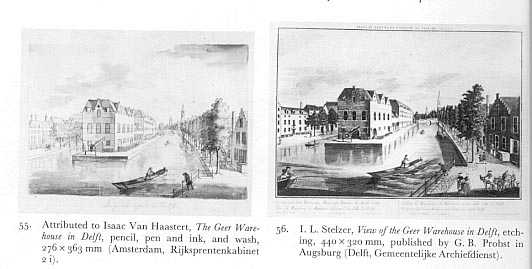
Josef Carmine (1770- c.1830) both etched and published about 150 different views with captions in three languages. Other Augsburg publishers started a lawsuit against this 'miserable charlatan' who produced mediocre work and also spied on other publishers. Dominikus Fietta (active 1788-1807) both etched and published about 40 different views with captions in three languages. He was one of Remondini's many agents. The multilingual captions of the Augsburg publishers promoted the international sale probably more successfully than those from Paris, London or Bassano. Whereas they usually give the name of the publisher, it is unusual to find the name of the designer or engraver. A number of examples are known of draughtsmen who had a long-term relationship with Augsburg publishers. The first is the German F. B. Werner (1690-1776) who travelled throughout Europe between 1727 and 1736 and drew profiles of towns and buildings for Augsburg publishers. The fact that he worked for several publishers at the same time cut down the cost.29 According to Ms. Angelika Marsch, who studied Werner extensively, he made sketches during the daytime and reworked these into drawings the size of the final print. He did this either at night, at the inn he stayed in, or in his workshop during the winter, when he was not travelling. A second draughtsman mentioned on views issued by Probst is Isaac van Haastert (1753-1834) from Delft. Three drawings in the Rijksmuseum print room, for which the artist and the purpose were not previously known, can be recognized as preparatory drawings for perspective views. The first drawing (fig. 54) shows the South End of Delft, on the right the Rotterdam gate and in the middle the Schiedam gate.30 The second drawing (fig. 55) shows the weapon warehouse 'magazijn de Geer' on the Geer canal (this building is also visible on the first drawing, to the left of the bridge). The third drawing, not reproduced here, shows the 'Hague gate' on the road to The Hague. These three drawings clearly constitute a series. Each sheet, roughly the same size (300 x 400 mm), has been folded in the same manner, and bears the same watermark. The titles form a characteristic feature because they are repeated at the bottom centre and at the top centre, worded slightly differently. On the bottom right- hand side are the monograms Jchi and Achi, whose meaning has not yet been determined. A perspective view published by Probst (fig. 56) is clearly based on the second drawing. The lettering on the print identifies the draughtsman as Isaac van Haastert, a local Delft artist. According to the documents of the St Luke's Guild he was one of the few professional artists at the time, and was chief (hooftman) of the Guild for a period around 1790. The manuals state that he painted, etched and engraved townscapes and village views, and later landscapes as well. His work can be seen in the municipal archive and in the municipal museum 'Het Prinsenhof' in Delft. The drawings were clearly not meant as finished works of art. In the first (fig. 54) the artist has redrawn the horses, and the skies have been left blank. They give a sterile, traced impression. Van Haastert did indeed trace over his black crayon outlines with pen and ink, but even these crayon lines have little of the character of a sketch. The architecture has been executed schematically, without hesitation or shakiness of line. All three drawings have been given a somewhat exaggerated perspective by stressing the orthogonal. Because the first drawing shows buildings frontally, Van Haastert had to perform some tricks. By choosing a wide angle, and adding perspective elements to the quay, ships and position of the masts, he succeeded in obtaining an illusion of depth. lt is notable that similar distortions were also added by the engraver. Comparison of figures 55 and 56 shows how he emphasized elements at both sides of the composition so as to stress the perspective; furthermore, so as to simplify the appearance of the building, Van Haastert left out one entire floor of the warehouse. The connection between Van Haastert and Probst was of some significance. Many other views of Delft and other nearby towns such as The Hague and Schiedam published by Probst bear his name as draughtsman. They also collaborated in a series of smaller sized topographical prints of a more artistic nature. In this series, the buildings' outlines are less important and textures have been depicted.
Perspective views produced in The Netherlands
 Outside Augsburg, in
The Hague, an isolated series of
perspective views were produced by Hendrik Scheurleer (1734-1768).
He etched and issued a series of 30 views of The Hague and nearby
towns in the regular size of a perspective view. His technique is
topographically reliable hut artistically somewhat awkward. One of
Scheurleer's copper plates, a view of the royal House in the
Woods in The Hague found its way to the publisher Robert Sayer
in London. Sayer then erased Scheurleer's name and replaced it with
his own, as was the normal procedure at the time. Impressions of
both versions can be found in the Rijksmuseum print room. The
decline in popularity of the perspective view between 1790 and 1850
is difficult to explain, but stereoscopic photographs, which
appeared on the market after circa 1850 entirely superseded
perspective views because of their superior illusion of depth.
Outside Augsburg, in
The Hague, an isolated series of
perspective views were produced by Hendrik Scheurleer (1734-1768).
He etched and issued a series of 30 views of The Hague and nearby
towns in the regular size of a perspective view. His technique is
topographically reliable hut artistically somewhat awkward. One of
Scheurleer's copper plates, a view of the royal House in the
Woods in The Hague found its way to the publisher Robert Sayer
in London. Sayer then erased Scheurleer's name and replaced it with
his own, as was the normal procedure at the time. Impressions of
both versions can be found in the Rijksmuseum print room. The
decline in popularity of the perspective view between 1790 and 1850
is difficult to explain, but stereoscopic photographs, which
appeared on the market after circa 1850 entirely superseded
perspective views because of their superior illusion of depth.
The Rarekiek or Peep show box.
 The
urge to create the artificial illusion of depth, as seen in the
stereoscope (forerunner of the view master), is very old. Although
a "novelty" in the 19th. century, the artificial illusion of depth
was not new at all! 18th. Century projection techniques where able
to conjure up spectacular 3-dimensional ghosts by Phantasmagoria
techniques.
The
urge to create the artificial illusion of depth, as seen in the
stereoscope (forerunner of the view master), is very old. Although
a "novelty" in the 19th. century, the artificial illusion of depth
was not new at all! 18th. Century projection techniques where able
to conjure up spectacular 3-dimensional ghosts by Phantasmagoria
techniques.
Even the 17th. Century perspective boxes (see Samuel van
Hoogstraten), besides many other wondrous effects, where able to
surprise their viewers with "realistic" true life images in
artificially constructed boxes using well thought-out anamorphic
principles.
 The PEEPSHOW
box (Boite d'OPTIQUE France - rarekiek Netherlands - mondo nuovo
Italy - GUCKKASTEN Germany) is much more simpler but also able to
create the depth illusion through viewing architectural &
topographical engravings with linear perspective via one large
bi-convex lens using our two eyes. The bi-convex increase the 3-D
illusion of the often exaggerated perspective views, (Vue d'
Optique). Since also colours have their own focusing point, these
also help in creating a surprising depth in details. Red, for
example, is often seen "floating" above the lines of an engraving,
an astonishing effect! The image below illustrate a typical, late
17th. century or early 18th., Century Rarekiek made in oak. The main cause however for the illusion of depth, seen and experienced
in a vintage Peepshow, is the artificially often exaggerated
perspective of these hand coloured engravings seen through one
bi-convex lens with a large diameter and small dioptre.
The PEEPSHOW
box (Boite d'OPTIQUE France - rarekiek Netherlands - mondo nuovo
Italy - GUCKKASTEN Germany) is much more simpler but also able to
create the depth illusion through viewing architectural &
topographical engravings with linear perspective via one large
bi-convex lens using our two eyes. The bi-convex increase the 3-D
illusion of the often exaggerated perspective views, (Vue d'
Optique). Since also colours have their own focusing point, these
also help in creating a surprising depth in details. Red, for
example, is often seen "floating" above the lines of an engraving,
an astonishing effect! The image below illustrate a typical, late
17th. century or early 18th., Century Rarekiek made in oak. The main cause however for the illusion of depth, seen and experienced
in a vintage Peepshow, is the artificially often exaggerated
perspective of these hand coloured engravings seen through one
bi-convex lens with a large diameter and small dioptre.
Correct use of these optical prints can create
wondrous "day and night effects" combined with a 3-D true life
illusion. Views meant to be seen in a Rarekiek (Dutch word for
Peepshow) are often pierced in appropriate details (windows, street
lights, moon & stars, artificial fire work..., etc.) and
ameliorated with coloured transparent paper for enchanting effects.
The true forerunner of the dissolving effect.
Figures painted on tissue paper mounted in window openings is
another most effective translucent painting technique. Opaque
cut-out details, mounted on the rear of a print, can conjure up
romantic "against the light" effects, even in views without pierced
parts.
In analogy with the above explained optical boxes (showing a view
of far-away and unknown places), the internet is today's peepshow
and window to the world, offering a wealth of images and
information only by looking into our monitor.
This late 18th., century Rarekiek, however, worked
with candles as a light source. The light emission of 4 candles was
sufficient to conjure-up enchanting night scenes.
Two double candle holders in iron were used to illuminate the vue
d' optiques from behind when daylight was not available.
For night effects during the day, the candle holders were removed
to enable daylight illuminating the engravings from behind in a
closed box.


=================NOTES================
As this text was electronically scanned in 2001 from the printed edition, minor errors may occur. Please see the printed copy when professionally referring to this article.
This published article is an elaborated version of one published in Dutch (De Boekenwereld, 1, nos. 2 and 3, 1985). I should like to thank all those colleagues, in Germany, France, ltaly, Holland and England, who have offered invaluable assistance, in particular the following: Drs. F. J. Heijbroek of the Rijksmuseum and editor of De Boekenwereld who generously edited my original draught, Mr. M. D. Haga, also of the Rijksmuseum, who suggested I write about the Van Haastert drawings; Marie van Dijk of the Meertens-Institute who kindly allowed me to read her research notes; Antony Griffiths of the British Museum and Anne Lyles for their enthusiastic help; and also Angelika Marsch, Wolfgang Seitz, Véronique Léry - and finally Brenda Kaldenbach who edited the text and helped with the artwork. The only collection which I have systematically examined is that in the Rijksmuseum.
1. The most important literature on perspective views is the following: F. Pouy, Les anciennes vues d'optique Amiens 1883; H. Elsner von Gronow, 'Guckkasten und Guckkastenbilder', Orpho XXIII, 1932, pp. 1-53; E. de Keyser, 'Un domaine méconnu de I'Imagerie: Les Vues d'Optique', Bulletin de la Societé' Le vieux Papier', XXIII, fáscicule 198, 1962, pp. 137- 68. V. Léry, 'Les Vues d'Optique', 100 Vues d'optique et curiosités, exhibition catalogue, Pontoise Museum 1977, and W. Seitz, 'Augsburger Vedutenstecher der 18. jhdt. Daten und Werke' (typescript), Augsburg 1982. Literature on the viewing machines is described below.
2. This term is that most commonly used in English; the machine was also often known as 'zograscope'. The term used in Dutch is optica, which is derived from the French optique. In Germany the machine is a Guckkasten and in ltaly it is the Camera Ottica. See also p. 90.
3. De Keyser (op. cit., pp. 143-44) claimed that no perspective Views were published before 1725, dismissing as copies (after existing prints) those views which A. Dubois had argued ('Les Vues d'Optique', Bulletin de la Societé 'Le vieux papier' XXII 1958/60) could be dated to the same year as the events they depicted (variously 1677, 1678 and 1687). Keyser also claimed (idem, p. 146) that Perspective views only began to decline in popularity as late as 1820.
4. J . Bischoff, Beyträge zur Optik, Ulm, Frankfurt, Leipzig 1764, quoted by Elsner von Gronow, op. cit, p. 14.
5. See J. A. Chaldecott, 'The zograscope or 'optical diagonal machine', Annals of Science, IX, no. 4, 1953; sec also T. H. Court and M. von Rohr, 'On old instrurnents both for the accurate drawing and correct viewing of perspectives" The Photographic journal, LXXV, Feb. 1935, pp. 54-66 for other material on English viewing devices.
6. For further information on Dutch devices or the situatin in Holland, see J. W. Enschedé, 'Optica-prenten', Oude kunst, V', 1920-21, pp. 11-17 and 40-41, L. Schalckens, 'Ontspanning in het verleden: De optica uit de 18de eeuw en later', De Brabantse folklore, CLI, 1961, pp. 247-83, and G. A. Brongers, 'De illuminatiekast en de opticaspiegel', Antieke rariteiten, Bussum 1967, pp. 57-69.
7. In 1984 two of these Optical stereoscopes came up for sale in an antique shop dealing in scientific instruments on the Ponte Vecchio in Florence.
8. This catalogue is one of a collection of over 150 book-sale catalogues dating from 1769-1788 (when the trade in Perspective views was at its height) which I consulted at the Society for the Advancement of Interest in the Book Trade in the Library of the University of Amsterdam, where thousands more are housed.
9. J.C. Kohlhans, Neu-erfundene Mathematische und Optische Curiositäten, Leipzig 1677; for this quotation in German see Elsner von Gronow, op. cit., pp. 11 - 12.
1O. S. Parrat, 'Optic machine improved" The Gentlemans Magazine and Historical Chronicler, XXIII, 1753, p. 171. See another article by Parrat, on 'How to view perspectives, The Gentleman's Magazine and Historical Chronicler., 1749, p. 534-35.
11. E. G. Guyot, Nouvelles récréations mathématiques et Physiques, Paris 1770. Guyot also described the illuminating box and the Peep-show, comparable with those made by children today.
12. M. van Dijk, 'Spel en speelcultuur in de negentiende eeuw, een onderzoek naar vrijetijdsrelieten in boedelinventarissen', Volkskundig Bulletin, no. 9, 1983, pp. 53-81 - By the second half ofthe nincteenth century, optical instruments are rarely mentioned in inventory lists.
13. H. Elsner von Gronow, op. cit., p. 16.
14. P. Casselie, 'Le commerce de l'estampe á Paris dans la seconde moitié du 18e siècle', thesis, Ecole des Chartes 1976. I am grateful to Marianne Grivel of the Bibliothèque Nationale for bringing this thésis to my attention.
15. Catalogo dalle stampe in rame ... di Giuseppe Remondini e Figli ... 1772. Photocopies of this and of the 1784 catalogue were kindly sent to me by the Biblioteca Comunale, Musco Civico, Bassano.
16. Comparative figures such as these should, of course, only be taken as a general indication of the variation in prices from country to country, since they are taken from different sources, that is dealer's catalogues and inventories of estates. The rates of exchange were provided by Mr Seegers of the Economie Historie Archive, Amsterdam.
17. See note 8.
18. See also De Keyser, op. cit., p. 144 for further discussion on this argument.
19. These six were selected on the advice of Antony Griffiths. See further his article, 'A Checklist of catalogues of British Print Publishers c. 1650--1830', Print Quarterly, 1, 1984, pp. 4-22.
20. Rijksmuseum, nv. no. 32.478, 389 x 229 mm.
21. Rijksmuseum, inv. no. 21.803.
22. Rijksmuseum, inv. no. 21.646.
23. Rijksmuseum, inv. no. 21.781.
24. Op. cit. in note 1 - Véronique Léry of the Louvre has recently compieted a thesis on French perspective views.
25. Op. cit., in note 1.
26. De Keyser (p, 146) notes that plates were frequently sold between publishers, and that the later owners added their own address to these formerly on the plate.
27. For the Remondini see de Keyser, op. cit., pp. 155-57 and A. Bertorelli, L'imagerie populaire italienne, Paris 1929 pp. 88-97.
28. Information on Augsburg Production is drawn from the type-script by W. Seitz, cited in note 1. He welcomes information on perspective views and other types of Augsburg view at Karlstrasse 2, 8900 Augsburg. See also de Keyser op. cit., pp. 148-153.
29. Various series of city views after Werner's drawings put out by different publishers are known. Seitz has recorded 117 views published by Wolff-Probst, -29 (size 365 x 415 mm) and 94 size 215 x 310 m") by Engelbrecht, 222 by Leopold and 86 by Haffner.
30. For a discussion op views of this area see Arthur K. Wheeloek jr. and C. J. (Kees) Kaldenbach 'Vermeer's view of Delft and his vision of reality, in Artibus et Historiae, III, 1982, 6. See this article in Publications under author.
http://www.cichw.net/pmprints.html Stresses this pioneering work and the author states about my flow chart: "Moreover, the chart omits Sayer & Bennett's extremely comprehensive catalogue for the year 1775." I thank the author for this remark.
For a recent discussion and updated literature see the fine book by Richard Balzer, Peepshows, a Visual History, Abrams New York, 1998.
Kees Kaldenbach. Updated April 15, 2004
Optical prints in Japan.
From the 17th century, Japanese noble scholars adopted western knowledge of cannons, medical science and natural science, especially natural history.
In 1720 Tokugawa Yoshimune eased restrictions on imports of western books except those related to Christianity. This easing of restrictions greatly assisted studies prevailing in Japan of medical science, astronomy and the solar calendar. With the increased import of many different books, prints, paintings of lower quality and glass pictures, some painters and members of wealthy class in Japan came to accept the western artistic rationale with regard to composition and expression which stressed texture and three-dimensional effect.
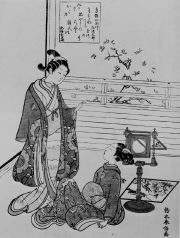 Japanese artists
learned western techniques on their own mainly from illustrations
or prints in Dutch books. Shiba Kokan (1747-1818), a
western-style painter representing the Edo period created the first
Japanese etchings based on illustrations in a Dutch everyday
encyclopedia, the Dictiotiare Oncyclopedia edited by Noel Chomel
(1633-1712). Kokan obtained from the Amsterdam copper printer Jan
Luiken prints from his populair work "Spiegel van Het Menselyk
Bedryf" and he produced the first real oil paintings in Japan based
on this work. He named these oil paintings "Ranga" (Dutch
paintings).
Japanese artists
learned western techniques on their own mainly from illustrations
or prints in Dutch books. Shiba Kokan (1747-1818), a
western-style painter representing the Edo period created the first
Japanese etchings based on illustrations in a Dutch everyday
encyclopedia, the Dictiotiare Oncyclopedia edited by Noel Chomel
(1633-1712). Kokan obtained from the Amsterdam copper printer Jan
Luiken prints from his populair work "Spiegel van Het Menselyk
Bedryf" and he produced the first real oil paintings in Japan based
on this work. He named these oil paintings "Ranga" (Dutch
paintings).
The optical mirror or Zograscope and the optical prints imported from the Netherlands stimulated Japanese painters who applied Western vision to the expression of landscapes. This Western vision also provided inspiration for the woodblock prints of landscapes by Hokusai and Hiroshige.
Dutch art played a very important role in cultivating an understanding Western rationale, while Dutch maps gave the Japanese a new recognition of the world at the end of 19th century, when modern civilization began to be absorbed in earnest.
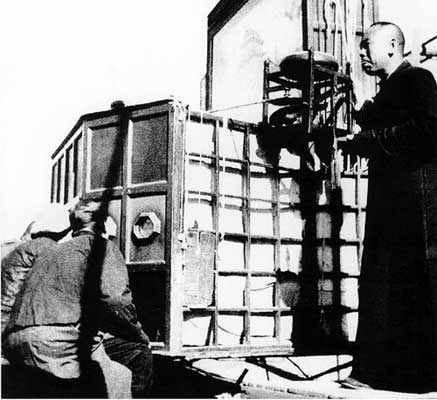
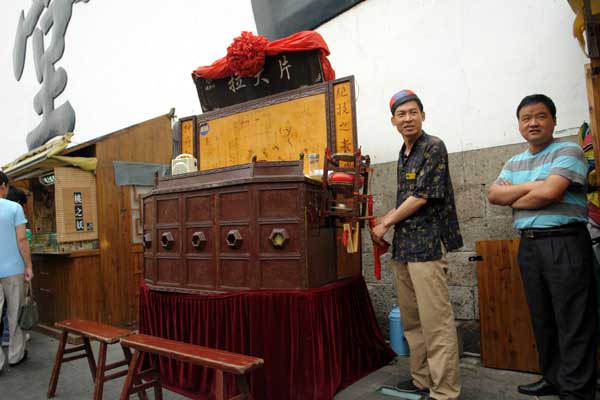
Optical prints in China
Also
China knows a long history of optical prints; with the difference
that even to-day the original Peepshow still exists. Below is a
photograph taken on the first of May 2006 in Hefang Street
Hangzhou, China.
The drawing on top of the peepshow depict the viewing apparatus in
use on the photograph.
Like in 19th century Europe, now-a-days itinerant Peepshowmen are
often seen in smaller towns in China.
This huge peepshow has 5 peepholes to enable 5 people to enjoy the
hidden world of an old but still vivid tradition.