
Librairie Loeb-Larocque
La Librairie  |   Commander  |   Vente aux enchères  |   Liens  |   Contactez-Nous  |   Accueil  |   English version
 

AFRIQUE


Continent africain


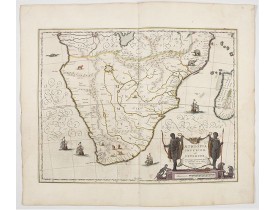
101 HONDIUS, J.Jr. Africae nova Tabula. Amsterdam, 1623. Col. Cropped on the neat line somtimes just effecting the printed area, carefully re-margined for protective reason. The outer left and right neat lines re-drawn. Centerfold reinforced. For the rest in good condition. Very attractive map. 453 x 558 mm.
Inquire about item N°63326 .

2500 €   buy now

¤ A second state of this very rare "carte à figures" map. Decorated with the four decorative borders by Jodocus Hondius Jr.
This remarkable map of Africa was first offered in 1619 as a separately published map and is based on a map by his father, Jodocus Hondius (1563-1612) of 1606. While the general geography for this map is taken from Willem Blaeu’s wall map of 1608 and his 1617 folio map, this example represents a considerable advance in the detail and accuracy of Africa from Hondius’ prior maps.
Geographical improvements include a more rounded southern Cape, the naming of the Rio de Spiritu Santo and of the CuamaRiver, the insertion of Zimbaos and alteration in the shape of Madagascar. The Kingdom of Monomotapa fills the entire southern tip of Africa.
However, the map is also filled with fictitious rivers and mountains and shows the origin of the Nile conforming to the Ptolemaic tradition of twin lakes located below the equator, as is typical of 17th Century cartography. - Schilder, Monumenta, volume6, 13.2. Betz, 60.2


   zoom map   enlarge map

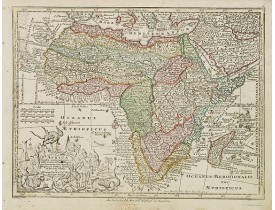
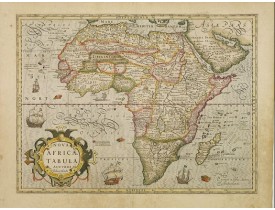
102 MERCATOR,G./ HONDIUS,J. Nova Africae Tabula. Amsterdam, 1630. In original colours. A good and strong impression. centerfold strengthened. With some later colour addition. 373 x 501 mm.
Inquire about item N°14974 .

2100 €   buy now

¤ An attractive map of the continent, added by Hondius when he took over publication of Mercator's Atlas. Although it is based on Mercator's map, Hondius improved the outline of Madagascar, and named Cape False and Saldanha Bay.
Richly ornamented map of the continent. Decorative title cartouche surrounded by a wreath and topped with an animal head. There are five ships under full sail. Flying fish and various sea monsters decorate the sea. Elephants and dromedary occupy the interior. Mercator was born in Rupelmonde in Flanders and studied in Louvain under Gemma Frisius, Dutch writer, astronomer and mathematician. The excellence of his work brought him the patronage of Charles V, but in spite of his favour with the Emperor he was caught up in the persecution of Lutheran protestants and charged with heresy, fortunately without serious consequences. No doubt the fear of further persecution influenced his move in 1552 to Duisburg, where he continued the production of maps, globes and instruments. - Tooley, Africa p.54.


   zoom map   enlarge map

103 HONDIUS,H. / JANSSONIUS, J. Africae nova Tabula. Amsterdam, 1632. Coloured. Usual paper age-toning. Repair of split lower part center fold, 3cm. into engraved area. 410 x 550 mm.
Inquire about item N°25374 .

4000 €   buy now

¤ Fine map of Africa, it's the issue of Jodocus Hondius map, with decorative borders on three sides. There are six ships in full sail on the Atlantic and one to the south of Madagascar. Flying fish and various monsters decorate the sea. Neptune and a mermaid are riding the waves lower left. ¤ Norwich, Maps of Africa, map 34.


   zoom map   enlarge map

104 BLAEU,W. Africae nova descriptio. Amsterdam, 1640. Coloured. Right hand margin cut short, in upper part shaving the engraved area, now reinforced and the outer line carefully re-drawn. For the rest an attractive copy. 410 x 553 mm.
Inquire about item N°26618 .

4500 €   buy now

¤ Much of the geographical information is still based on the Ptolemaic maps, with the Nile shown with its source in the Lakes Zaire and Zaflan. Also included are various other mythical lakes and rivers including the famous Lake Sachaf of Laurent Fries. Only coastal towns are named on the Cape, with the printing covering much of the Unknown territory.
Decorated with elephants, lions, ostriches etc. on the land areas, and ships and sea monsters on the sea.
With columns on either side depicting ten views of the native manner of dress and nine city and town plans above.


   zoom map   enlarge map

105 BLAEU,W. Africae nova descriptio. Amsterdam, 1645. Col. ancien. In very attractive colours, heightened with gold. Very good and dark impression. Very good throughout. German text on verso. 410 x 553 mm.
Inquire about item N°12318 .

6000 €   buy now

¤ Much of the geographical information is still based on the Ptolemaic maps, with the Nile shown with its source in the Lakes Zaire and Zaflan. Also included are various other mythical lakes and rivers including the famous Lake Sachaf of Laurent Fries. Only coastal towns are named on the Cape, with the printing covering much of the Unknown territory. Decorated with elephants, lions, ostriches etc. on the land areas, and ships and sea monsters on the sea. With columns on either side depicting ten views of the native manner of dress and nine city and town plans above.


   zoom map   enlarge map

Afrique du nord


106 ORTELIUS, A. Barbariae et Biledulgerid, nova descriptio. Anvers, 1598. Beau col. Texte français. 326 x 496 mm.
Inquire about item N°60032 .

650 €   buy now

¤ North-West Africa. Koeman speculated: "In view of the important trading relationship between Antwerp and Africa, it is not impossible that the original was a manuscript map of Portuguese or Venetian origin. In this map, Ortelius gives a number of details found on no other printed map of the period". - Van den Broecke, Ortelius Atlas maps, 176.


   zoom map   enlarge map

Algérie


107 BRAUN, G. / HOGENBERG, F. ALGERII Sarace norum urbis fortissimae. Cologne, 1580. Beau col. Texte français. Infimes rousseurs. 345 x 490 mm.
Inquire about item N°60408 .

600 €   buy now

¤ An attractive plan of the Alger, including a numbered key legend in the lower part. From the greatest publication in this genre!. The "Civitates" was compiled and written by George Braun, Canon of Cologne Cathedral. Braun gathered together vast amounts of information and draft plans to produce over 500 city views/maps published in six parts between 1572 and 1617.


   zoom map   enlarge map

108 OTTENS, R. / J. Nouvelle carte du Roiaume D'Alger divisée en toutes ses provinces, avec une partie due cotes D'Espagne . . . Amsterdam, 1720. Original colours. A good and dark impression. Mint condition, printed on heavy paper. 440 x 560 mm.
Inquire about item N°27990 .

500 €   buy now

¤ Rare and detailed map of the coast of Algeria. Large inset map of the Bay of Alger (El-Jazir). Shows a coastline of Spain around Alicante. Two compass roses in the Mediterreanen.


   zoom map   enlarge map

109 ROUX,J. [73] Barbarie. Oran.. Marseille 1764. Col. Sea chart on heavy paper with sharp impression. 130 x 200 mm.
Inquire about item N°12845 .

50 €   buy now

¤ Charming chart of the harbour of the town of Oran in Algeria. Showing town and harbor plan, with soundings, anchorages, rocks, shoals, fortifications and lighthouses. Joseph Roux (1725-1793) was a Marseilles hydrographer who both published and as well manufactured and sold charts, navigating instruments and related nautical equipment. At about the mid-century, he received the right to be called "Hidrographe du Roy," and in 1764 published a series of 12 charts of the Mediterranean; he simultaneously published a smaller format atlas of 65 harbor chart. - Smith, The Artful Roux.


   zoom map   enlarge map

Tunisie


110 ROUX,J. [70] Tunis. Marseille 1764. Col. Sea chart on heavy paper with sharp impression. 127 x 200 mm.
Inquire about item N°12842 .

50 €   buy now

¤ Charming chart of the coasts near the town of Tunis. Showing town and harbor plan, with soundings, anchorages, rocks, shoals, fortifications and lighthouses. Joseph Roux (1725-1793) was a Marseilles hydrographer who both published and as well manufactured and sold charts, navigating instruments and related nautical equipment. At about the mid-century, he received the right to be called "Hidrographe du Roy," and in 1764 published a series of 12 charts of the Mediterranean; he simultaneously published a smaller format atlas of 65 harbor chart. - Smith, The Artful Roux.


   zoom map   enlarge map

Maroc


111 MERCATOR,G./ HONDIUS,J. Fessae et Marocchi Regna. Amsterdam, 1630. In original colours. A good and strong impression. Paper slightly browned, as usual. Alltogether in very good condition. 356 x 482 mm.
Inquire about item N°12852 .

800 €   buy now

¤ One of the new maps added by Hondius, when he took over publication of the Atlas, a finely engraved and decorative map of north-west Africa, with the Canaries. With an inset of the island of Penon de Veles. Mercator was born in Rupelmonde in Flanders and studied in Louvain under Gemma Frisius, Dutch writer, astronomer and mathematician. The excellence of his work brought him the patronage of Charles V, but in spite of his favor with the Emperor he was caught up in the persecution of Lutheran protestants and charged with heresy, fortunately without serious consequences. No doubt the fear of further persecution influenced his move in 1552 to Duisburg, where he continued the production of maps, globes and instruments. Mercator's sons and grandsons, were all cartographers and made their contributions in various ways to his atlas. Rumold, in particular, was responsible for the complete edition in 1595. The map plates were bought in 1604 by Jodocus Hondius who, with his sons, Jodocus II and Henricus, published enlarged editions which dominated the map market for the following twenty to thirty years.


   zoom map   enlarge map

112 AVELINE,P. / CREPY Tanger. Paris, 1690-1720. Some minor marginal water staining. Good condition. 194 x 308 mm.
Inquire about item N°13114 .

300 €   buy now

¤ A very RARE panoramic view of the city of Tangier. Engraved by Pierre Aveline (Paris, c.1656 - 23 May 1722). He was also a print-publisher and print-seller. He probably trained with Adam Pérelle and, like him, specialized in topographical representations. He engraved in suites many views of Paris and of provincial, European and African cities, mixing etching and burin. In 1685 he obtained a royal license for ten years, authorizing him to reproduce 'le profil des maisons royales'. Among the 412 items that comprise his oeuvre, there are only two portraits and two prints of historical subjects. The print carries the "privilege du Roy". With the publishers address of "Crepy". Etienne Louis Crepy (c.1700-1759) was active as an engraver and publisher active at rue St.Jacques a StPierre in Paris. He was specializing in maps and geographical prints. In 1731 he acquired the stock of copper plates of topographical content from his father Jean Crepy. Collectors item!. - Thieme-B. II, 273 (Aveline)


   zoom map   enlarge map

113 ROUX,J. [75] Barbarie.. Mamora.. Salee Marseille 1764. Col. Sea chart on heavy paper with sharp impression. 130 x 200 mm.
Inquire about item N°12905 .

50 €   buy now

¤ Charming chart of including the harbours of Mamora, Salee, etc. Showing town and harbor plan, with soundings, anchorages, rocks, shoals, fortifications and lighthouses. Joseph Roux (1725-1793) was a Marseilles hydrographer who both published and as well manufactured and sold charts, navigating instruments and related nautical equipment. At about the mid-century, he received the right to be called "Hidrographe du Roy," and in 1764 published a series of 12 charts of the Mediterranean; he simultaneously published a smaller format atlas of 65 harbor chart. - Smith, The Artful Roux.


   zoom map   enlarge map

Egypte


114 BRAUN, G. / HOGENBERG, F. Cairus, quae olim Babylon, … Cologne, 1590. Col. Habilement restauré le long du pli central. 335 x 485 mm.
Inquire about item N°60659 .

800 €   buy now

¤ Contemporaneous bird's-eye view of the city and surroundings showing the Pyramids and the Sphinx. Egypt had fallen to the Turks during the reign of Selim I at the beginning of the 16th century and this fine rather stylised pictorial plan shows the capital Cairo during early Ottoman rule. Behind a foreground group of travellers and horsemen, the sweeping line of River Nile with the City and its environs beyond. The map includes representations of the famous Pyramids and Sphinx at Gaza to the right, as well as illustrations of crocodiles in the Nile River.


   zoom map   enlarge map

115 LOTTER,C. Le cours entier du grand et Fameux Nil.. Augsbourg, 1760. In original colours. In attractive full colours. A good and dark impression. Mint. 483 x 598 mm.
Inquire about item N°5814 .

750 €   buy now

¤ Scarce. A splendid map of ancient Egypt. West is at the top and the Nile bisects Egypt. A inset shows "modern Egypt" to good detail. With the Red Sea and part of the Arabian Peninsular. Fine cartouche and detail with Pyramids, Nile waterfalls, etc. With tracks from Dereira to Jerusalem and All Zark in Arabia.


   zoom map   enlarge map

116 PRISSE D'AVENNES, E. Khosné Ahmed el Bordeyny. Paris, 1877. In original colours. A very nice copy. 470 x 330 mm.
Inquire about item N°61324 .

200 €   buy now

¤ Lithograph by Lemoine and Schmidt representing an old man smoking chicha and teaching the Qoran to a young boy. From the author's "L'Art Arabe d'après les monuments du Kaire…". Emile Prisse d'Avennes, Orientalist & Muslim convert, obsessive in his attention to detail, was after Champollion the greatest pre-20th century Egyptologist. His interests were not, however, limited to Egyptology & he produced this, one of the most important books on the Islamic monuments of Egypt. A French nobleman by birth, though impoverished, Prisse d'Avennes seems to have spent his life in the pursuit of the exotic. After a period fighting for Greek independence Prisse d'Avennes travelled to India, a journey that prefigured his extensive Middle Eastern travels, which during the next 40 years took him to Palestine, Syria, Sudan, Ethiopia, Arabia, Persia, & most importantly Egypt & Algeria where he lived. Like Coste, Prisse d'Avennes worked for the Viceroy Mehmet Ali until 1836. After that he explored Egypt on his own disguised as an Arab using the name Edris Effendi. In 1860, Prisse d'Avennes returned to France with the fruits of his travels: 300 folio drawings, 400 metres of bas-reliefs, 150 photographs of important architectural details, 150 sketches & daguerrotypes & numerous plans, details & elevations copied on the scene. Until his death in 1877 this wealth of material was to occupy him completely as he sought to organise it for publication.


   zoom map   enlarge map

117 PRISSE D'AVENNES, E. Sibyl d'Ahmed Hoceyn Margouch. Paris, 1877. Uncoloured. Slightly brown spotted. A nice copy. 500 x 320 mm.
Inquire about item N°61329 .

200 €   buy now

¤ Lithograph by Fichou. From the author's "L'Art Arabe d'après les monuments du Kaire…". Emile Prisse d'Avennes, Orientalist & Muslim convert, obsessive in his attention to detail, was after Champollion the greatest pre-20th century Egyptologist. His interests were not, however, limited to Egyptology & he produced this, one of the most important books on the Islamic monuments of Egypt. A French nobleman by birth, though impoverished, Prisse d'Avennes seems to have spent his life in the pursuit of the exotic. After a period fighting for Greek independence Prisse d'Avennes travelled to India, a journey that prefigured his extensive Middle Eastern travels, which during the next 40 years took him to Palestine, Syria, Sudan, Ethiopia, Arabia, Persia, & most importantly Egypt & Algeria where he lived. Like Coste, Prisse d'Avennes worked for the Viceroy Mehmet Ali until 1836. After that he explored Egypt on his own disguised as an Arab using the name Edris Effendi. In 1860, Prisse d'Avennes returned to France with the fruits of his travels: 300 folio drawings, 400 metres of bas-reliefs, 150 photographs of important architectural details, 150 sketches & daguerrotypes & numerous plans, details & elevations copied on the scene. Until his death in 1877 this wealth of material was to occupy him completely as he sought to organise it for publication.


   zoom map   enlarge map

118 PRISSE D'AVENNES,E. Beyt El-Emyr. Paris, 1877. Uncoloured. Lithography on tinted grounds. A fine copy. 505 x 325 mm.
Inquire about item N°61326 .

120 €   buy now

¤ Lithograph by Mouilleron representing a young woman looking over a beautiful moucharabieh. From the author's "L'Art Arabe d'après les monuments du Kaire…". Emile Prisse d'Avennes, Orientalist & Muslim convert, obsessive in his attention to detail, was after Champollion the greatest pre-20th century Egyptologist. His interests were not, however, limited to Egyptology & he produced this, one of the most important books on the Islamic monuments of Egypt. A French nobleman by birth, though impoverished, Prisse d'Avennes seems to have spent his life in the pursuit of the exotic. After a period fighting for Greek independence Prisse d'Avennes travelled to India, a journey that prefigured his extensive Middle Eastern travels, which during the next 40 years took him to Palestine, Syria, Sudan, Ethiopia, Arabia, Persia, & most importantly Egypt & Algeria where he lived. Like Coste, Prisse d'Avennes worked for the Viceroy Mehmet Ali until 1836. After that he explored Egypt on his own disguised as an Arab using the name Edris Effendi. In 1860, Prisse d'Avennes returned to France with the fruits of his travels: 300 folio drawings, 400 metres of bas-reliefs, 150 photographs of important architectural details, 150 sketches & daguerrotypes & numerous plans, details & elevations copied on the scene. Until his death in 1877 this wealth of material was to occupy him completely as he sought to organise it for publication.


   zoom map   enlarge map

119 PRISSE D'AVENNES,E. Beyt El-Emyr. Porte Extérieure du Harem. (XVIIe. siècle) Paris, 1877. Faint marginal foxing in lower right corner, hardly noticeable. A fine copy. Very good condition. 495 x 330 mm.
Inquire about item N°61787 .

150 €   buy now

¤ Lithograph by Mouilleron representing a woman in a long white hijab speaking with the guardian of a harem, in front of its entrance. From the author's "L'Art Arabe d'après les monuments du Kaire…". Emile Prisse d'Avennes, Orientalist & Muslim convert, obsessive in his attention to detail, was after Champollion the greatest pre-20th century Egyptologist. His interests were not, however, limited to Egyptology & he produced this, one of the most important books on the Islamic monuments of Egypt. A French nobleman by birth, though impoverished, Prisse d'Avennes seems to have spent his life in the pursuit of the exotic. After a period fighting for Greek independence Prisse d'Avennes traveled to India, a journey that prefigured his extensive Middle Eastern travels, which during the next 40 years took him to Palestine, Syria, Sudan, Ethiopia, Arabia, Persia, & most importantly Egypt & Algeria where he lived. Like Coste, Prisse d'Avennes worked for the Viceroy Mehmet Ali until 1836. After that he explored Egypt on his own disguised as an Arab using the name Edris Effendi. In 1860, Prisse d'Avennes returned to France with the fruits of his travels: 300 folio drawings, 400 metres of bas-reliefs, 150 photographs of important architectural details, 150 sketches & daguerreotypes & numerous plans, details & elevations copied on the scene. Until his death in 1877 this wealth of material was to occupy him completely as he sought to organize it for publication.


   zoom map   enlarge map

120 PRISSE D'AVENNES,E. Lampe du Tombeau du Soultan Beybars II. Paris, 1877. Uncoloured. Some brown spotting. In good condition. 475 x 320 mm.
Inquire about item N°61310 .

30 €   buy now

¤ Heliogravure from the author's "L'Art Arabe d'après les monuments du Kaire…". Emile Prisse d'Avennes, Orientalist & Muslim convert, obsessive in his attention to detail, was after Champollion the greatest pre-20th century Egyptologist. His interests were not, however, limited to Egyptology & he produced this, one of the most important books on the Islamic monuments of Egypt. A French nobleman by birth, though impoverished, Prisse d'Avennes seems to have spent his life in the pursuit of the exotic. After a period fighting for Greek independence Prisse d'Avennes travelled to India, a journey that prefigured his extensive Middle Eastern travels, which during the next 40 years took him to Palestine, Syria, Sudan, Ethiopia, Arabia, Persia, & most importantly Egypt & Algeria where he lived. Like Coste, Prisse d'Avennes worked for the Viceroy Mehmet Ali until 1836. After that he explored Egypt on his own disguised as an Arab using the name Edris Effendi. In 1860, Prisse d'Avennes returned to France with the fruits of his travels: 300 folio drawings, 400 metres of bas-reliefs, 150 photographs of important architectural details, 150 sketches & daguerrotypes & numerous plans, details & elevations copied on the scene. Until his death in 1877 this wealth of material was to occupy him completely as he sought to organise it for publication.


   zoom map   enlarge map

121 PRISSE D'AVENNES,E. Maison Appelée : Beyt El-Emir. Façade du Maqâad ou Iwan sur la Cour. (XVIIe. siècle) Paris, 1877. Some light brown foxing. Else very good condition. 500 x 325 mm.
Inquire about item N°61796 .

150 €   buy now

¤ Highly decorative lithography by Sorrieu & Mouilleron, representing architectural details of a house, namely the iwan's facade on the courtyard. From the author's "L'Art Arabe d'après les monuments du Kaire…".
Emile Prisse d'Avennes, Orientalist & Muslim convert, obsessive in his attention to detail, was after Champollion the greatest pre-20th century Egyptologist. His interests were not, however, limited to Egyptology and he produced this, one of the most important books on the Islamic monuments of Egypt.
A French nobleman by birth, though impoverished, Prisse d'Avennes seems to have spent his life in the pursuit of the exotic. After a period fighting for Greek independence Prisse d'Avennes traveled to India, a journey that prefigured his extensive Middle Eastern travels, which during the next 40 years took him to Palestine, Syria, Sudan, Ethiopia, Arabia, Persia, and most importantly Egypt and Algeria where he lived. Like Coste, Prisse d'Avennes worked for the Viceroy Mehmet Ali until 1836.
After that he explored Egypt on his own disguised as an Arab using the name Edris Effendi.
In 1860, Prisse d'Avennes returned to France with the fruits of his travels: 300 folio drawings, 400 metres of bas-reliefs, 150 photographs of important architectural details, 150 sketches, daguerreotypes, numerous plans, details and elevations copied on the scene.
Until his death in 1877 this wealth of material was to occupy him completely as he sought to organize it for publication.


   zoom map   enlarge map

122 PRISSE D'AVENNES,E. Maison Sidi Youçouf Adami. Paris, 1877. In original colours. A very nice copy. 470 x 325 mm.
Inquire about item N°61325 .

200 €   buy now

¤ Beautiful lithograph by Spiegel. From the author's "L'Art Arabe d'après les monuments du Kaire…". Emile Prisse d'Avennes, Orientalist & Muslim convert, obsessive in his attention to detail, was after Champollion the greatest pre-20th century Egyptologist. His interests were not, however, limited to Egyptology & he produced this, one of the most important books on the Islamic monuments of Egypt. A French nobleman by birth, though impoverished, Prisse d'Avennes seems to have spent his life in the pursuit of the exotic. After a period fighting for Greek independence Prisse d'Avennes travelled to India, a journey that prefigured his extensive Middle Eastern travels, which during the next 40 years took him to Palestine, Syria, Sudan, Ethiopia, Arabia, Persia, & most importantly Egypt & Algeria where he lived. Like Coste, Prisse d'Avennes worked for the Viceroy Mehmet Ali until 1836. After that he explored Egypt on his own disguised as an Arab using the name Edris Effendi. In 1860, Prisse d'Avennes returned to France with the fruits of his travels: 300 folio drawings, 400 metres of bas-reliefs, 150 photographs of important architectural details, 150 sketches & daguerrotypes & numerous plans, details & elevations copied on the scene. Until his death in 1877 this wealth of material was to occupy him completely as he sought to organise it for publication.


   zoom map   enlarge map

123 PRISSE D'AVENNES,E. Monument Sépulcral près de Kymân El-Gyouchy. (XVIIIe. siècle) Paris, 1877. Some light brown foxing. Else very good condition. 360 x 478 mm.
Inquire about item N°61797 .

250 €   buy now

¤ Highly decorative lithography by Asselineau, representing a mausoleum. From the author's "L'Art Arabe d'après les monuments du Kaire…".
Emile Prisse d'Avennes, Orientalist & Muslim convert, obsessive in his attention to detail, was after Champollion the greatest pre-20th century Egyptologist. His interests were not, however, limited to Egyptology and he produced this, one of the most important books on the Islamic monuments of Egypt.
A French nobleman by birth, though impoverished, Prisse d'Avennes seems to have spent his life in the pursuit of the exotic. After a period fighting for Greek independence Prisse d'Avennes traveled to India, a journey that prefigured his extensive Middle Eastern travels, which during the next 40 years took him to Palestine, Syria, Sudan, Ethiopia, Arabia, Persia, and most importantly Egypt and Algeria where he lived. Like Coste, Prisse d'Avennes worked for the Viceroy Mehmet Ali until 1836.
After that he explored Egypt on his own disguised as an Arab using the name Edris Effendi.
In 1860, Prisse d'Avennes returned to France with the fruits of his travels: 300 folio drawings, 400 metres of bas-reliefs, 150 photographs of important architectural details, 150 sketches, daguerreotypes, numerous plans, details and elevations copied on the scene.
Until his death in 1877 this wealth of material was to occupy him completely as he sought to organize it for publication.


   zoom map   enlarge map

124 PRISSE D'AVENNES,E. Mosquée de Mohammed Ben Qalaoûn. Details du Minaret Partie Inférieure. (XIVe. siècle) Paris, 1877. Close to excellent condition. 500 x 260 mm.
Inquire about item N°61788 .

100 €   buy now

¤ Highly decorative lithography by Asselineau, showing architectural details of the minaret of Qalaoûn's mosque in Cairo. From the author's "L'Art Arabe d'après les monuments du Kaire…". Emile Prisse d'Avennes, Orientalist & Muslim convert, obsessive in his attention to detail, was after Champollion the greatest pre-20th century Egyptologist. His interests were not, however, limited to Egyptology & he produced this, one of the most important books on the Islamic monuments of Egypt. A French nobleman by birth, though impoverished, Prisse d'Avennes seems to have spent his life in the pursuit of the exotic. After a period fighting for Greek independence Prisse d'Avennes traveled to India, a journey that prefigured his extensive Middle Eastern travels, which during the next 40 years took him to Palestine, Syria, Sudan, Ethiopia, Arabia, Persia, & most importantly Egypt & Algeria where he lived. Like Coste, Prisse d'Avennes worked for the Viceroy Mehmet Ali until 1836. After that he explored Egypt on his own disguised as an Arab using the name Edris Effendi. In 1860, Prisse d'Avennes returned to France with the fruits of his travels: 300 folio drawings, 400 metres of bas-reliefs, 150 photographs of important architectural details, 150 sketches & daguerreotypes & numerous plans, details & elevations copied on the scene. Until his death in 1877 this wealth of material was to occupy him completely as he sought to organize it for publication.


   zoom map   enlarge map

125 PRISSE D'AVENNES,E. Mosquée de Mohammed Ben Qalaoûn. Vue du Mihrab. (XIVe. siècle) Paris, 1877. Some light brown spotting. Else very good condition. 500 x 321 mm.
Inquire about item N°61786 .

250 €   buy now

¤ Highly decorative lithography by Sorrieu, representing the Mihrab inside Sultan Qalaoûn's mosque in Cairo. From the author's "L'Art Arabe d'après les monuments du Kaire…". Emile Prisse d'Avennes, Orientalist & Muslim convert, obsessive in his attention to detail, was after Champollion the greatest pre-20th century Egyptologist. His interests were not, however, limited to Egyptology & he produced this, one of the most important books on the Islamic monuments of Egypt. A French nobleman by birth, though impoverished, Prisse d'Avennes seems to have spent his life in the pursuit of the exotic. After a period fighting for Greek independence Prisse d'Avennes traveled to India, a journey that prefigured his extensive Middle Eastern travels, which during the next 40 years took him to Palestine, Syria, Sudan, Ethiopia, Arabia, Persia, & most importantly Egypt & Algeria where he lived. Like Coste, Prisse d'Avennes worked for the Viceroy Mehmet Ali until 1836. After that he explored Egypt on his own disguised as an Arab using the name Edris Effendi. In 1860, Prisse d'Avennes returned to France with the fruits of his travels: 300 folio drawings, 400 metres of bas-reliefs, 150 photographs of important architectural details, 150 sketches & daguerreotypes & numerous plans, details & elevations copied on the scene. Until his death in 1877 this wealth of material was to occupy him completely as he sought to organize it for publication.


   zoom map   enlarge map

126 PRISSE D'AVENNES,E. Mosquée d'El-Bordeyny. Intérieur de la Salle Principale. (XVIIe. siècle) Paris, 1877. Beau col. ancien. Colour-lithography on tinted grounds. Faint marginal foxing on the left side, hardly noticeable. In very good condition. 500 x 325 mm.
Inquire about item N°61799 .

200 €   buy now

¤ Highly decorative lithography by G. Sanier, showing the main room of El-Bordeyny's mosque. From the author's "L'Art Arabe d'après les monuments du Kaire…". Emile Prisse d'Avennes, Orientalist & Muslim convert, obsessive in his attention to detail, was after Champollion the greatest pre-20th century Egyptologist. His interests were not, however, limited to Egyptology & he produced this, one of the most important books on the Islamic monuments of Egypt. A French nobleman by birth, though impoverished, Prisse d'Avennes seems to have spent his life in the pursuit of the exotic. After a period fighting for Greek independence Prisse d'Avennes traveled to India, a journey that prefigured his extensive Middle Eastern travels, which during the next 40 years took him to Palestine, Syria, Sudan, Ethiopia, Arabia, Persia, & most importantly Egypt & Algeria where he lived. Like Coste, Prisse d'Avennes worked for the Viceroy Mehmet Ali until 1836. After that he explored Egypt on his own disguised as an Arab using the name Edris Effendi. In 1860, Prisse d'Avennes returned to France with the fruits of his travels: 300 folio drawings, 400 metres of bas-reliefs, 150 photographs of important architectural details, 150 sketches & daguerreotypes & numerous plans, details & elevations copied on the scene. Until his death in 1877 this wealth of material was to occupy him completely as he sought to organize it for publication.


   zoom map   enlarge map

127 PRISSE D'AVENNES,E. Mosquée du Soultan Haçen. Grande Porte. (XIVe. siècle) Paris, 1877. Faint marginal foxing, hardly noticeable. Else very good condition. 495 x 320 mm.
Inquire about item N°61800 .

200 €   buy now

¤ Highly decorative lithography by B. Schmidt, showing the imposing entrance of Sultan Haçen's mosque. From the author's "L'Art Arabe d'après les monuments du Kaire..". Emile Prisse d'Avennes, Orientalist & Muslim convert, obsessive in his attention to detail, was after Champollion the greatest pre-20th century Egyptologist. His interests were not, however, limited to Egyptology & he produced this, one of the most important books on the Islamic monuments of Egypt. A French nobleman by birth, though impoverished, Prisse d'Avennes seems to have spent his life in the pursuit of the exotic. After a period fighting for Greek independence Prisse d'Avennes traveled to India, a journey that prefigured his extensive Middle Eastern travels, which during the next 40 years took him to Palestine, Syria, Sudan, Ethiopia, Arabia, Persia, & most importantly Egypt & Algeria where he lived. Like Coste, Prisse d'Avennes worked for the Viceroy Mehmet Ali until 1836. After that he explored Egypt on his own disguised as an Arab using the name Edris Effendi. In 1860, Prisse d'Avennes returned to France with the fruits of his travels: 300 folio drawings, 400 metres of bas-reliefs, 150 photographs of important architectural details, 150 sketches & daguerreotypes & numerous plans, details & elevations copied on the scene. Until his death in 1877 this wealth of material was to occupy him completely as he sought to organize it for publication.


   zoom map   enlarge map

128 PRISSE D'AVENNES,E. Mosquée sépulcrale de Soultan Barqouq. Porte du Tombeau. (XIVe. siècle) Paris, 1877. Marginal water stains attaining the right corners of the lithographed area. Else very good conditions. 500 x 325 mm.
Inquire about item N°61785 .

250 €   buy now

¤ Lithograph by Philippe Benoist. Representing a religious reading the Qoran inside Sultan Barqouq's mosque. From the author's "L'Art Arabe d'après les monuments du Kaire…". Emile Prisse d'Avennes, Orientalist & Muslim convert, obsessive in his attention to detail, was after Champollion the greatest pre-20th century Egyptologist. His interests were not, however, limited to Egyptology & he produced this, one of the most important books on the Islamic monuments of Egypt. A French nobleman by birth, though impoverished, Prisse d'Avennes seems to have spent his life in the pursuit of the exotic. After a period fighting for Greek independence Prisse d'Avennes traveled to India, a journey that prefigured his extensive Middle Eastern travels, which during the next 40 years took him to Palestine, Syria, Sudan, Ethiopia, Arabia, Persia, & most importantly Egypt & Algeria where he lived. Like Coste, Prisse d'Avennes worked for the Viceroy Mehmet Ali until 1836. After that he explored Egypt on his own disguised as an Arab using the name Edris Effendi. In 1860, Prisse d'Avennes returned to France with the fruits of his travels: 300 folio drawings, 400 metres of bas-reliefs, 150 photographs of important architectural details, 150 sketches & daguerreotypes & numerous plans, details & elevations copied on the scene. Until his death in 1877 this wealth of material was to occupy him completely as he sought to organize it for publication.


   zoom map   enlarge map

129 PRISSE D'AVENNES,E. Porte du bain appelé Hammam El-Télat. Paris, 1877. Uncoloured. A fine copy. 490 x 325 mm.
Inquire about item N°61322 .

150 €   buy now

¤ Lithograph by Asselineau showing two indigenous and an ass in front of the building. From the author's "L'Art Arabe d'après les monuments du Kaire…". Emile Prisse d'Avennes, Orientalist & Muslim convert, obsessive in his attention to detail, was after Champollion the greatest pre-20th century Egyptologist. His interests were not, however, limited to Egyptology & he produced this, one of the most important books on the Islamic monuments of Egypt. A French nobleman by birth, though impoverished, Prisse d'Avennes seems to have spent his life in the pursuit of the exotic. After a period fighting for Greek independence Prisse d'Avennes travelled to India, a journey that prefigured his extensive Middle Eastern travels, which during the next 40 years took him to Palestine, Syria, Sudan, Ethiopia, Arabia, Persia, & most importantly Egypt & Algeria where he lived. Like Coste, Prisse d'Avennes worked for the Viceroy Mehmet Ali until 1836. After that he explored Egypt on his own disguised as an Arab using the name Edris Effendi. In 1860, Prisse d'Avennes returned to France with the fruits of his travels: 300 folio drawings, 400 metres of bas-reliefs, 150 photographs of important architectural details, 150 sketches & daguerrotypes & numerous plans, details & elevations copied on the scene. Until his death in 1877 this wealth of material was to occupy him completely as he sought to organise it for publication.


   zoom map   enlarge map

130 PRISSE D'AVENNES,E. Porte du Palais du Soultan Beybars. (XIIIe. siècle) Paris, 1877. Very good condition. 490 x 327 mm.
Inquire about item N°61790 .

150 €   buy now

¤ Highly decorative lithography by Ch. Fichot, showing the walled-up entrance of Sultan Beybars' palace. From the author's "L'Art Arabe d'après les monuments du Kaire…".
Emile Prisse d'Avennes, Orientalist & Muslim convert, obsessive in his attention to detail, was after Champollion the greatest pre-20th century Egyptologist. His interests were not, however, limited to Egyptology and he produced this, one of the most important books on the Islamic monuments of Egypt.
A French nobleman by birth, though impoverished, Prisse d'Avennes seems to have spent his life in the pursuit of the exotic. After a period fighting for Greek independence Prisse d'Avennes traveled to India, a journey that prefigured his extensive Middle Eastern travels, which during the next 40 years took him to Palestine, Syria, Sudan, Ethiopia, Arabia, Persia, and most importantly Egypt and Algeria where he lived. Like Coste, Prisse d'Avennes worked for the Viceroy Mehmet Ali until 1836.
After that he explored Egypt on his own disguised as an Arab using the name Edris Effendi.
In 1860, Prisse d'Avennes returned to France with the fruits of his travels: 300 folio drawings, 400 metres of bas-reliefs, 150 photographs of important architectural details, 150 sketches, daguerreotypes, numerous plans, details and elevations copied on the scene.
Until his death in 1877 this wealth of material was to occupy him completely as he sought to organize it for publication.


   zoom map   enlarge map

131 PRISSE D'AVENNES,E. Porte d'une Maison Rue Chérawy. Au Kaire. (XIVe. siècle) Paris, 1877. Very good condition. 495 x 325 mm.
Inquire about item N°61789 .

200 €   buy now

¤ Highly decorative lithography by Sorrieu, showing the entrance of a house in Cairo. From the author's "L'Art Arabe d'après les monuments du Kaire…".
Emile Prisse d'Avennes, Orientalist & Muslim convert, obsessive in his attention to detail, was after Champollion the greatest pre-20th century Egyptologist. His interests were not, however, limited to Egyptology and he produced this, one of the most important books on the Islamic monuments of Egypt.
A French nobleman by birth, though impoverished, Prisse d'Avennes seems to have spent his life in the pursuit of the exotic. After a period fighting for Greek independence Prisse d'Avennes traveled to India, a journey that prefigured his extensive Middle Eastern travels, which during the next 40 years took him to Palestine, Syria, Sudan, Ethiopia, Arabia, Persia, and most importantly Egypt and Algeria where he lived. Like Coste, Prisse d'Avennes worked for the Viceroy Mehmet Ali until 1836.
After that he explored Egypt on his own disguised as an Arab using the name Edris Effendi.
In 1860, Prisse d'Avennes returned to France with the fruits of his travels: 300 folio drawings, 400 metres of bas-reliefs, 150 photographs of important architectural details, 150 sketches, daguerreotypes, numerous plans, details and elevations copied on the scene.
Until his death in 1877 this wealth of material was to occupy him completely as he sought to organize it for publication.


   zoom map   enlarge map

132 PRISSE D'AVENNES,E. Principale Porte de la Citadelle. Bâb El-A'Zab. (XIIIe. siècle) Paris, 1877. Beau col. ancien. Faint marginal foxing on the right side. In very good condition. 325 x 403 mm.
Inquire about item N°61802 .

n €   buy now

¤ Highly decorative lithography by Monthelier & Bayot, showing the main entrance of a stronghold. From the author's "L'Art Arabe d'après les monuments du Kaire…". Emile Prisse d'Avennes, Orientalist & Muslim convert, obsessive in his attention to detail, was after Champollion the greatest pre-20th century Egyptologist. His interests were not, however, limited to Egyptology & he produced this, one of the most important books on the Islamic monuments of Egypt. A French nobleman by birth, though impoverished, Prisse d'Avennes seems to have spent his life in the pursuit of the exotic. After a period fighting for Greek independence Prisse d'Avennes traveled to India, a journey that prefigured his extensive Middle Eastern travels, which during the next 40 years took him to Palestine, Syria, Sudan, Ethiopia, Arabia, Persia, & most importantly Egypt & Algeria where he lived. Like Coste, Prisse d'Avennes worked for the Viceroy Mehmet Ali until 1836. After that he explored Egypt on his own disguised as an Arab using the name Edris Effendi. In 1860, Prisse d'Avennes returned to France with the fruits of his travels: 300 folio drawings, 400 metres of bas-reliefs, 150 photographs of important architectural details, 150 sketches & daguerreotypes & numerous plans, details & elevations copied on the scene. Until his death in 1877 this wealth of material was to occupy him completely as he sought to organize it for publication.


   zoom map   enlarge map

133 PRISSE D'AVENNES,E. Tombeau Attribué à Mahmoud Djanum. (XVIe. siècle) Paris, 1877. Some light brown foxing. Else very good condition. 335 x 460 mm.
Inquire about item N°61793 .

200 €   buy now

¤ Highly decorative lithography by Sorrieu, representing Mahmud Djanum's mausoleum. From the author's "L'Art Arabe d'après les monuments du Kaire…".
Emile Prisse d'Avennes, Orientalist & Muslim convert, obsessive in his attention to detail, was after Champollion the greatest pre-20th century Egyptologist. His interests were not, however, limited to Egyptology and he produced this, one of the most important books on the Islamic monuments of Egypt.
A French nobleman by birth, though impoverished, Prisse d'Avennes seems to have spent his life in the pursuit of the exotic. After a period fighting for Greek independence Prisse d'Avennes traveled to India, a journey that prefigured his extensive Middle Eastern travels, which during the next 40 years took him to Palestine, Syria, Sudan, Ethiopia, Arabia, Persia, and most importantly Egypt and Algeria where he lived. Like Coste, Prisse d'Avennes worked for the Viceroy Mehmet Ali until 1836.
After that he explored Egypt on his own disguised as an Arab using the name Edris Effendi.
In 1860, Prisse d'Avennes returned to France with the fruits of his travels: 300 folio drawings, 400 metres of bas-reliefs, 150 photographs of important architectural details, 150 sketches, daguerreotypes, numerous plans, details and elevations copied on the scene.
Until his death in 1877 this wealth of material was to occupy him completely as he sought to organize it for publication.


   zoom map   enlarge map

134 PRISSE D'AVENNES,E. Tombeau de Soultan Qalaoûn. Paris, 1877. Uncoloured. Lithography on tinted grounds. A fine copy. 490 x 325 mm.
Inquire about item N°61327 .

180 €   buy now

¤ Lithograph by Bernard Schmidt representing the tomb of sultan Ibn Qalaoun, founder of the mamluk dynasty during the 13th century. The tomb has some rich stained glass and stucco work. From the author's "L'Art Arabe d'après les monuments du Kaire…". Emile Prisse d'Avennes, Orientalist & Muslim convert, obsessive in his attention to detail, was after Champollion the greatest pre-20th century Egyptologist. His interests were not, however, limited to Egyptology & he produced this, one of the most important books on the Islamic monuments of Egypt. A French nobleman by birth, though impoverished, Prisse d'Avennes seems to have spent his life in the pursuit of the exotic. After a period fighting for Greek independence Prisse d'Avennes travelled to India, a journey that prefigured his extensive Middle Eastern travels, which during the next 40 years took him to Palestine, Syria, Sudan, Ethiopia, Arabia, Persia, & most importantly Egypt & Algeria where he lived. Like Coste, Prisse d'Avennes worked for the Viceroy Mehmet Ali until 1836. After that he explored Egypt on his own disguised as an Arab using the name Edris Effendi. In 1860, Prisse d'Avennes returned to France with the fruits of his travels: 300 folio drawings, 400 metres of bas-reliefs, 150 photographs of important architectural details, 150 sketches & daguerrotypes & numerous plans, details & elevations copied on the scene. Until his death in 1877 this wealth of material was to occupy him completely as he sought to organise it for publication.


   zoom map   enlarge map

135 PRISSE D'AVENNES,E. Tombeau du Soultan Tarabey. (XVIe. siècle) Paris, 1877. Light marginal foxing in lower part. Some brown spotting. Else very good condition. 335 x 460 mm.
Inquire about item N°61792 .

250 €   buy now

¤ Highly decorative lithography by Ch. Fichot, representing Sultan Tarabey's mausoleum. From the author's "L'Art Arabe d'après les monuments du Kaire…".
Emile Prisse d'Avennes, Orientalist & Muslim convert, obsessive in his attention to detail, was after Champollion the greatest pre-20th century Egyptologist. His interests were not, however, limited to Egyptology and he produced this, one of the most important books on the Islamic monuments of Egypt.
A French nobleman by birth, though impoverished, Prisse d'Avennes seems to have spent his life in the pursuit of the exotic. After a period fighting for Greek independence Prisse d'Avennes traveled to India, a journey that prefigured his extensive Middle Eastern travels, which during the next 40 years took him to Palestine, Syria, Sudan, Ethiopia, Arabia, Persia, and most importantly Egypt and Algeria where he lived. Like Coste, Prisse d'Avennes worked for the Viceroy Mehmet Ali until 1836.
After that he explored Egypt on his own disguised as an Arab using the name Edris Effendi.
In 1860, Prisse d'Avennes returned to France with the fruits of his travels: 300 folio drawings, 400 metres of bas-reliefs, 150 photographs of important architectural details, 150 sketches, daguerreotypes, numerous plans, details and elevations copied on the scene.
Until his death in 1877 this wealth of material was to occupy him completely as he sought to organize it for publication.


   zoom map   enlarge map

136 PRISSE D'AVENNES,E. Tombeau d'un Emir. (XIIIe. siècle) Paris, 1877. Close to excellent condition. 490 x 320 mm.
Inquire about item N°61791 .

150 €   buy now

¤ Highly decorative lithography by Ch. Fichot, showing the walled-up entrance door of Sultan Beybars' palace. From the author's "L'Art Arabe d'après les monuments du Kaire…".
Emile Prisse d'Avennes, Orientalist & Muslim convert, obsessive in his attention to detail, was after Champollion the greatest pre-20th century Egyptologist. His interests were not, however, limited to Egyptology and he produced this, one of the most important books on the Islamic monuments of Egypt.
A French nobleman by birth, though impoverished, Prisse d'Avennes seems to have spent his life in the pursuit of the exotic. After a period fighting for Greek independence Prisse d'Avennes traveled to India, a journey that prefigured his extensive Middle Eastern travels, which during the next 40 years took him to Palestine, Syria, Sudan, Ethiopia, Arabia, Persia, and most importantly Egypt and Algeria where he lived. Like Coste, Prisse d'Avennes worked for the Viceroy Mehmet Ali until 1836.
After that he explored Egypt on his own disguised as an Arab using the name Edris Effendi.
In 1860, Prisse d'Avennes returned to France with the fruits of his travels: 300 folio drawings, 400 metres of bas-reliefs, 150 photographs of important architectural details, 150 sketches, daguerreotypes, numerous plans, details and elevations copied on the scene.
Until his death in 1877 this wealth of material was to occupy him completely as he sought to organize it for publication.


   zoom map   enlarge map

Canaries


137 GOOS,P. Caarte voor.. Canarise Eylanden als Canaria, Tenerifa.. Amsterdam, 1666. Coloured. On double-ply paper as issued. Paper very mildly age-toned, as usual. A good and dark impression. 422 x 524 mm.
Inquire about item N°12106 .

1250 €   buy now

¤ Very rare chart of the Canaries. Showing Palma, Ferro, Tenerife, Gran Canaria, Forte Ventura, Lancerota. In upper right hand corner inset of harbour of Lancerota. Pieter Goos (ca. 1616-1675) was one of the most important cartographer, engraver, publisher and print seller of Amsterdam. His widow continued business at her husband's death. She re-issued 'Nieuwe Groote Zee-Spiegel" in 1676.


   zoom map   enlarge map

Afrique centrale


138 MORTIER, P. Carte particuliere de L'Isle Dauphine ou Madagascar. Amsterdam, 1720. In strong original colours. In mint condition. Compass-rose and town spots heightened with gold. 562 x 851 mm.
Inquire about item N°3087 .

1800 €   buy now

¤ An impressive large sheet map of the island of Madagascar. Numerous place names, soundings and sand banks are shown round the island and the regions are defined in original body colour. East to the top. Including the islands of "I. De Bourbon", "Santa Apolonia", "I. De Ioan de Lisboa" and "Isles de Comorre". In lower left hand corner inset map of Bay St.Augustin. In lower left corner inset map of Bay St.Augustin. The regions are defined in original body colour. From Mortier's "Neptune François", one of the most spectacular cartographical works ever produced. According to Koeman: "...the most expensive sea-atlas ever published in Amsterdam ... Its charts are larger and more lavishly decorated than those of any preceding book of this kind.
For the engraving and etching Mortier had recruited the most qualified artists. This magnificent work was intended more as a show piece than something to be used by pilots at sea." The most beautiful charts in the atlas were those in part two, by the celebrated artist, Romeyn de Hooghe. Campbell says that when "found in the full colouring characteristic of their time, they are among the most magnificent of any age." This is a particularly beautiful example, with the full original colour praised by Campbell, and further illuminated with a liberal application of gold-leaf.


   zoom map   enlarge map

Afrique orientale


139 SANSON, N. / MARIETTE, P. Isle D'Auphine, communement Nommée par les Europeens Madagascar. Paris, 1667. Limites en col. ancien. Coupée au niveau du filet d'encadrement et renmargée. Mouillure à l'extrémité droite du pli central. - Contemporarily cut till plate mark and re-margined. Water stain at the right extremity of centerfold, affecting the scale border. 582 x 448 mm.
Inquire about item N°23228 .

1200 €   buy now

¤ Carte de Madagascar comprenant les Îles Comores et l'Île de la Réunion. Ornée d'un cartouche de titre, d'une rose des vents et d'un vaisseau. - Fine map of Madagascar, also showing the Comoros Islands in the North West and the Reunion Island in the South East.
With decorative title cartouche representing some natives, a compass rose and a vessel in the Indian Ocean.


   zoom map   enlarge map

140 CORONELLI, V.M. Isola di Madagascar o di S. Lorenzo Scoperta dà Portoghesi nell anno 1506. . . Venice, 1690. Uncoloured. Good and dark impression. Good margins. Paper slightly age-toned. 600 x 450 mm.
Inquire about item N°25986 .

600 €   buy now

¤ Decorative and highly detailed map of Madagascar, including 2 decorative cartouches and other embellishments.
The remarkable Vincenzo Coronelli (1650-1718), was a Franciscan Friar and appointed General of the Order in 1701. He was cosmographer to the Republic of Venice and founder of the Academia Cosmografica degli Argonauti, the world's first geographical society (1680).
He was also one of the most prominent mapmakers and publishers in Europe of his day.


   zoom map   enlarge map

141 COVENS, J. / MORTIER, C. Carte du Congo et du Pays des Cafres. Amsterdam c. 1745. Original o/l colour. Printed on heavy paper, slightly age-toned as usual. Good impression. Excellent condition. 500 x 610 mm.
Inquire about item N°21457 .

750 €   buy now

¤ Detailed copper-engraved map of southern Africa providing numerous particulars and comments concerning European trade, native kingdoms, and mineral wealth.
Includes Madagascar and several islands in the Indian Ocean.
The map is from a Dutch edition of De L'Isle's work entitled, Atlas Nouveau, Contenant Toutes Les Parties Du Monde, Ou sont exactement Remarquées les Empires, Monarchies, Royaumes, Etats, Republiques &c. Par Guillaume de l'Isle. Premier Géographe de sa Majesté. It was published by Covens and Mortier, brothers-in-law who continued the firm established by Pierre Mortier.


   zoom map   enlarge map

142 VAUGONDY, R. de Isle de Madagascar ou de St. Laurent et Isles de la Réunion, Séchelles et Rodrigue. Paris, later than 1748. In original o/l colours. Very crisp and fine image. Good margins. Minor marginal water staining along upper border. Else very good condition. 166 x 193 mm.
Inquire about item N°24616 .

100 €   buy now

¤ Charming small map showing Madagascar, the Seychelles and other minor islands in the Indian Ocean.
From Atlas Portatif Universel, by Robert de Vaugondy.
Page 84 outside border top right. Mary Sponberg Pedley does not mention a state without date. - Pedley, Bel et utile, map 443, not mentioning this state.


   zoom map   enlarge map

143 SCHALL / LE GRAND, A. L'Enfance de Paul et Virginie. Paris, ca. 1790. Trace de pli transversal. - Belle impression. - Very good condition. Dark impression. 395 x 455 mm.
Inquire about item N°11857 .

350 €   buy now

¤ Peint par Schall et gravé par A. Legrand. - Bernardin de Saint Pierre's novel Paul and Virginie was first published in 1788 and became an instant best seller. The story generated numerous visual illustrations produced independently of the text.


   zoom map   enlarge map

Afrique occidentale


144 GOOS,P Pascaerte van 't Westelyckste Deel van Oost Indien, van C.. Amsterdam, 1666. Coloured. On double-ply paper as issued. Paper very mildly age-toned, as usual. A good and dark impression. 443 x 539 mm.
Inquire about item N°12087 .

3000 €   buy now

¤ An eye-catching chart of the western part of the Indian Ocean and its adjacent coasts of East Africa, Arabia with the Red Sea and the Arabian Gulf, Iran, Pakistan and western India. Pieter Goos (ca. 1616-1675) was one of the most important cartographer, engraver, publisher and print seller of Amsterdam. His widow continued business at her husband's death. She re-issued 'Nieuwe Groote Zee-Spiegel" in 1676.


   zoom map   enlarge map

Afrique du Sud


145 BLAEU, G. Aethiopia inferior, vel exterior. Amsterdam, 1645. Beau col. ancien. A fine copy in attractive colours. Very slight water staining in upper margin hardly affecting the engraved area. 378 x 496 mm.
Inquire about item N°6729 .

1050 €   buy now

¤ The standard map of South Africa throughout the 17th century. The lake out of which the 'Zambere' -the Zambesi- flows is probably based on reports of Lake Ngami, undiscovered until 1849. Then 20 miles long, it is today only marshland.
Some minor browning outer part margin. French text on verso. - Tooley: Africa p.29.


   zoom map   enlarge map

English version   |   LA LIBRAIRIE   |   VENTES / EXPERTISE    |   L'ACTUALITÉ SUR LOEB-LAROCQUE.COM news feed   |   CONTACTEZ-NOUS English