BÜNTING, H. - Asia secunda pars terrae in forma Pegasi.
Click on image to zoom
New
BÜNTING, H. - Asia secunda pars terrae in forma Pegasi.
Published: Brunswick, 1640
Size: 275 x 365mm.
Color: Uncoloured.
Condition: German text on verso. Fine dark impression with small margins at three sides, only at bottom trimmed with slight loss of lettering. Unobtrusive marginal imperfections mended.
Description
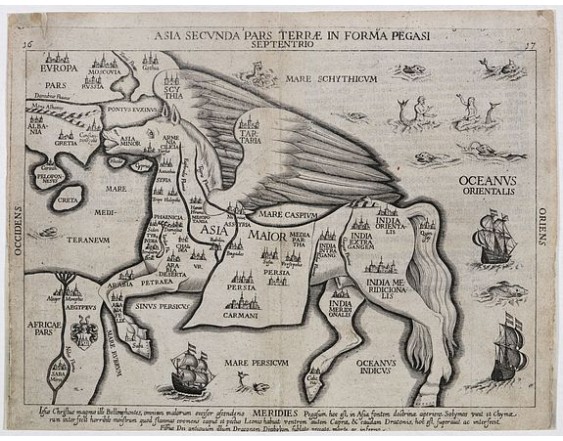
Asia depicted as the flying horse Pegasus. Double page copper engraved map from Heinrich Bünting's “Itinerarium Sacrae Scripturae”, printed in Brunswick around 1640 (whereas the “ordinary” Bünting Pegasus from the several Magdeburg editions is a woodcut print). Below the depiction 3 lines of engraved Latin text. Verso German explanatory text.
Extremely rare copper engraved Brunswick version of the Pegasus-map. On this state more symbols and decorative features have been added to the map: Ships, a mermaid and a merman as well as other fabulous sea-monsters in the oceans, more and bigger skeleton profile views to town-names and a coat of arms inside the Egypt boundaries. To sum it up, this state is more decorative than the plain, unpretentious 1st state. - Fine dark impression with small margins at three sides, only at bottom trimmed with slight loss of lettering. Unobtrusive marginal imperfections mended. A really rare piece of Cartographical Curiosa.
Bünting's work Itinerarium Sacrae Scriptura was essentially a theological commentary with other maps of great curiosity.
The title of this map is Asia Secunda Pars Terrae in Forma Pegasi (’Asia, the Second Part of the Earth, in the Form of Pegasus‘). The winged horse of Greek mythology is the son of Poseidon and Medusa, was tamed by Athena and became the horse of the Muses. This obviously pagan origin of the image makes its appearance in a Holy Land travel book a bit of a mystery.
On this map, Pegasus is drawn realistically – i.e. Asia is adjusted to horse-shape.
- Asia’s front legs, touching Africa with the knees, constitute Arabia.
- Its head, licking Europe, is Asia Minor (present-day Turkey).
- The Tigris and Euphrates rivers run down its neck, on which is marked the area of Mesopotamia.
- Another river indicated, at the horse’s thigh, is the Ganges, with India Infra Gangem (‘India before the Ganges’) to the west and India Extra Gangem (‘India across the Ganges’).
- The horse’s behind is India Orientalis (’East India‘, which could be used for parts east of present-day India, e.g. Indonesia, formerly the Dutch East Indies).
- Both hind legs are inscribed with India Meridionalis (’South India’), which doesn’t at all reflect the single-peninsular nature of the Indian subcontinent.
- The wings are labeled Scythia and Tartaria, names often used to describe the vast unknown areas of Siberia.
- The body of water in between the wings and the horse’s body is the Caspian Sea.
Extremely rare copper engraved Brunswick version of the Pegasus-map. On this state more symbols and decorative features have been added to the map: Ships, a mermaid and a merman as well as other fabulous sea-monsters in the oceans, more and bigger skeleton profile views to town-names and a coat of arms inside the Egypt boundaries. To sum it up, this state is more decorative than the plain, unpretentious 1st state. - Fine dark impression with small margins at three sides, only at bottom trimmed with slight loss of lettering. Unobtrusive marginal imperfections mended. A really rare piece of Cartographical Curiosa.
Bünting's work Itinerarium Sacrae Scriptura was essentially a theological commentary with other maps of great curiosity.
The title of this map is Asia Secunda Pars Terrae in Forma Pegasi (’Asia, the Second Part of the Earth, in the Form of Pegasus‘). The winged horse of Greek mythology is the son of Poseidon and Medusa, was tamed by Athena and became the horse of the Muses. This obviously pagan origin of the image makes its appearance in a Holy Land travel book a bit of a mystery.
On this map, Pegasus is drawn realistically – i.e. Asia is adjusted to horse-shape.
- Asia’s front legs, touching Africa with the knees, constitute Arabia.
- Its head, licking Europe, is Asia Minor (present-day Turkey).
- The Tigris and Euphrates rivers run down its neck, on which is marked the area of Mesopotamia.
- Another river indicated, at the horse’s thigh, is the Ganges, with India Infra Gangem (‘India before the Ganges’) to the west and India Extra Gangem (‘India across the Ganges’).
- The horse’s behind is India Orientalis (’East India‘, which could be used for parts east of present-day India, e.g. Indonesia, formerly the Dutch East Indies).
- Both hind legs are inscribed with India Meridionalis (’South India’), which doesn’t at all reflect the single-peninsular nature of the Indian subcontinent.
- The wings are labeled Scythia and Tartaria, names often used to describe the vast unknown areas of Siberia.
- The body of water in between the wings and the horse’s body is the Caspian Sea.
4,500€
- Reference N°: 38710