Menu
Menu
Your Cart

FAIRBURN, John. - An Emblem of America / An Emblem of Africa / An Emblem of Asia / An Emblem of Europe.
FAIRBURN, John. -  An Emblem of America / An Emblem of Africa / An Emblem of Asia / An Emblem of Europe.
FAIRBURN, John. - An Emblem of America / An Emblem of Africa / An Emblem of Asia / An Emblem of Europe.
Published: London, 1798
Size: 360 x 255mm.
Color: Colored
Condition: Four mezzotints extensively handcoloured with watercolor and gouache. Slightly browning, restored and applied on Japan paper.

Description

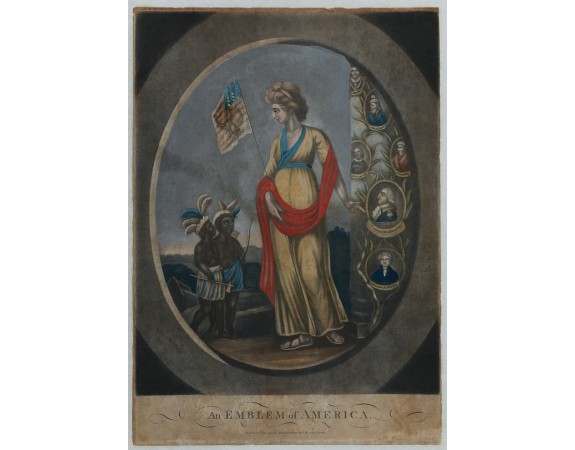
An Emblem of America : This white female figure of Columbia, emblematic of the United States, represents America in a set of prints of the Four Continents. Standing beside her are two dark-skinned boys wearing feathered head-dresses representing the Western Hemisphere, she directs their gaze to the column decorated with oval portraits of the individuals, who ‘discovered’ America, as well as the founders of the new nation. The list includes Christopher Columbus, “Americus” Vespucci, Sir Walter Raleigh, George Washington, Benjamin Franklin and John Adams.

Shortly after the British North American colonies gained independence from England in the late-eighteenth century, the female figure of Columbia became synonymous with American identity. However, personifications of North America developed as early as the sixteenth century, with early modern artists depicting Europe, Asia, Africa, and the Americas as female figures in prints, paintings, and sculptures. Artists depicted Europe as illustrious and cultivated to glorify its greatness, whereas, artists depicted North America as unrefined and uncivilized. America(s), depicted as an "Indian Princess," often wore a feathered headdress, feathered skirt, and a bow and arrow. The figure was regularly situated within a tropical landscape, sometimes holding a parrot or sitting on an enlarged alligator or oversized armadillo, based on their own ideas of Indigenous life in North America. By the eighteenth century, as the New World became less threatening to Europe, artists and allegorists began portraying North America as the neoclassical, white, female figure that became known as Columbia.
The African American child beside Columbia, dressed in the guise of a Native American figure, may be a representation of the "noble savage" trope. A highly offensive term first appearing in seventeenth century literature, the "noble savage" referred to someone who lives in nature, uncorrupted by civilization. French philosopher Jean-Jacques Rousseau later embraced the concept to highlight the corruption of European civilization in much of his eighteenth century discourse. Americans similarly embraced the stereotype after gaining Independence, as many artists in the late-eighteenth-and early-nineteenth-centuries created romanticized and falsified images of Indigenous peoples. The "primitive" and "simple" life of the ennobled "savage," many artists believed, juxtaposed the corruption of urban civilization
The African American figure in the painting might also be represented as a child on account of the dominant caricatures that depicted people of color as children in the eighteenth-and nineteenth-centuries. These offensive and harmful portrayals were intended to justify slavery, by instilling a paternalistic attitude in white masters and perpetuating the belief that they could serve as parental figures for enslaved people. This not only justified chattel slavery, but made it appear morally righteous. Regardless of whatever symbolism the artist had intended for the allegorical figures in this painting, it is no doubt suggestive of the widespread belief that people of color were considered lesser-than in the new nation.

An Emblem of Asia : Figurs a female figure wearing a turban with the Koran in his right hand. In the background are a pyramid, camels and an elephant with a palanquin.

An Emblem of Africa : Figurs a dark-skinned man with a bow and arrows wearing a turban and jewelry. In the background we can see a landscape with a river and near the figure a tent and a palm tree.

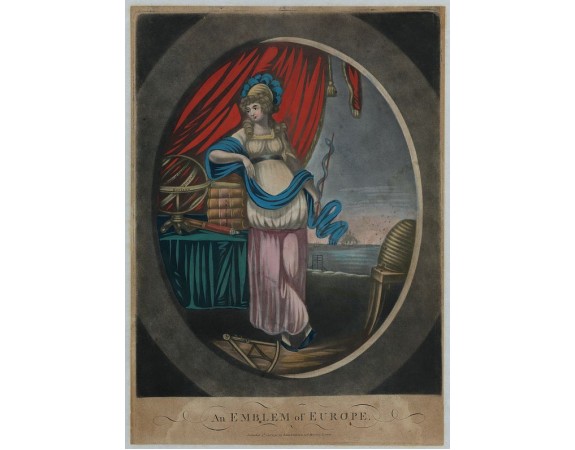
An Emblem of Europe : A female figure, leaning on books of fine arts surrounded by scientific instruments such as an armillary sphere, a spyglass and a sextant, holds a staff of Aesculapius in her left hand, the symbol of the traveler. In the background, we can see ships and a caravel sailing on the sea. All these elements symbolize European culture, travel and navigation.
1,700€
  • Reference N°: 49091

Some of the most asked FAQ by our clients

Librairie Loeb-Larocque specializes in maps, atlases, and travel books from the 16th to 19th centuries.
The Librairie was founded in 1958 by Louis Loeb-Larocque. Originally, he arrived in France from Germany shortly after World War II. He started an antiquarian map and book shop in Paris, specializing in early maps, atlases, travel books, and prints. The shop was located at Rue Le Peletier until 1996, and was frequently visited by collectors and fellow dealers from all parts of the world.
At present, the office is located at 31 rue de Tolbiac in Paris in the lively 13th district, a 5-minute walk from the Bibliothéque Nationale de France (Metro Line 14).
We welcome visitors to our shop by appointment, Monday through Friday.

MORE ABOUT LOEB-LAROCQUE
Librairie Loeb-Larocque sells authentic maps, prints, atlases, and rare books. We guarantee the authenticity and condition of each lot listed in our catalogs.
Browse the catalog now >>>
We supply a certificate for each item sold. Librairie Loeb-Larocque fully guarantees the authenticity and condition of each lot described in our catalogs. The warranty is unlimited in time. Defects in lots offered for sale have been carefully noted.
The term "color" means that the color is applied by hand.
- "Original colors / col. ancien-d' époque" means that the item was colored at or about the time of publication.
- "Colored/color" means that the map has recently been hand-colored within the last 50 years.

Measurements are given in centimeters; height is given first, excluding margins. Size is mentioned of the plate mark; height is given first. When there is no plate mark, we take the sizes of the illustration. In some instances, we additionally mention the size of the sheet in the condition field.

The date and place mentioned in our catalog is the date when the item was made and published. Where the publishing date is approximate, then c. (circa) is used.
We do not sell reproductions!

Browse the catalog now >>>
The value of a rare book, atlas, globe, print, or map depends on rarity, condition, binding, provenance, and the significance of any inscriptions it may contain. Béatrice Loeb-Larcque, an expert and member of the Syndicat Français des Experts Professionnels en Œuvres d'Art et Objets de Collection, provides a free appraisal if you are considering selling. We provide auction estimates from photographs sent via the Internet. These estimates are not for valuation purposes and are subject to revision upon inspection of the object. It is impossible to provide verbal estimates over the phone, nor can we respond to requests without a photo.

DO A VALUATION >>>
There is no easy answer to this question. Some books or maps have, without question, appreciated considerably in value over the years.
Others have remained steadily desirable without seeing a significant rise in price, and still others can be purchased for little money but give great personal satisfaction.
Librairie Loeb-Larocque, with 60 years of experience in the rare map and book trade, can help you decide what kind of collection you would like to build.
We buy antiquarian books in our areas of specialization: Atlases, old maps, travel books, and illustrated books.
If you want to sell books and maps, contact us for a free estimate. Send us photos by email, or make an appointment for a physical examination of the object. We will then make a purchase offer.

DO A FREE APPRAISAL >>>
Following the European Consumer Rights Directive, a buyer habitually residing in the European Union has the right to cancel the contract for the purchase of an item, without giving any reason.
The cancellation period will expire 14 calendar days from the day after the date on which you or a third party (other than the carrier and indicated by you) acquires physical possession of the lot.
To exercise the right to cancel, you must inform Joppen et Loeb Associates SARL, which is offering to sell the lot either as an agent for the seller or as the owner of the lot, of your decision to cancel this contract by a clear statement (e.g. a letter sent by post, 31 rue de Tolbiac, 75013 Paris France or e-mail (info @ loeb-larocque.com).


Browse the catalog now >>>
Parcels are shipped by DHL or registered mail and must be signed for. Insurance is included.
- We charge a flat shipping fee of 15 euros for shipments within France for shipments up to one kg.
- For parcels shipped within Europe, a flat 25,00 euros is charged.
-For shipments outside of Europe, the postal fee is 25.00 euros for the USA and Asia
- 45.00 euros for Africa and Australia for parcels up to one kg. Heavier parcels are shipped at a nominal postal fee.

Items are fully insured and usually shipped the day following payment. We ship maps and prints in sturdy tubes or strong packaging if necessary.

The items are shipped when your payment is received.
Browse the catalog now >>>
Visitors are welcome to our shop by appointment, Monday through Friday from 9 AM to 7 PM. We participate in fairs in Amsterdam, London, Venice, and often travel to find interesting items. Registered users receive monthly email updates. Follow us on Instagram or Facebook.
CONTACT US