
China

Location: 1599
Published: Frankfurt, 1599
Size: 140 x 177mm.
Color: Uncoloured.
Condition: Text sheet with copper plate engraving (140x177mm.) In very good condition, dark impression.
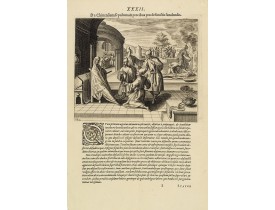
A scene of a funeral in China from Linschoten's famous voyages to the East of 1583-92 here published by De Bry the year after..
100€
Location: 1599
Published: Frankfurt, 1599
Size: 140 x 177mm.
Color: Uncoloured.
Condition: Text sheet with copper plate engraving (140x177mm.) In very good condition, dark impression.
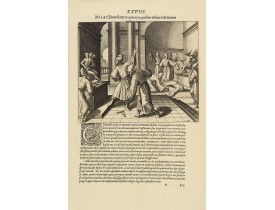
A religious scene in China Linschoten's famous voyages to the East of 1583-92 here published by De Bry the year after they fi..
100€
Location: 1599
Published: Frankfurt, 1599
Size: 140 x 177mm.
Color: Uncoloured.
Condition: Text sheet with copper plate engraving (140x177mm.) In very good condition, dark impression.
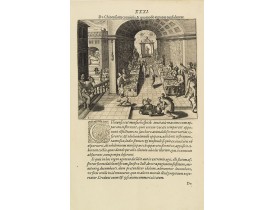
A scene of a Chinese dinner feast from Linschoten's famous voyages to the East of 1583-92 here published by De Bry the year a..
100€
Location: 1599
Published: Frankfurt, 1599
Size: 140 x 177mm.
Color: Uncoloured.
Condition: Text sheet with copper plate engraving (140x177mm.) In very good condition, dark impression.
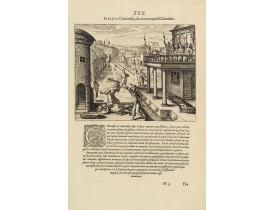
Punishment of a criminal in China from Linschoten's famous voyages to the East of 1583-92 here published by De Bry the year a..
100€
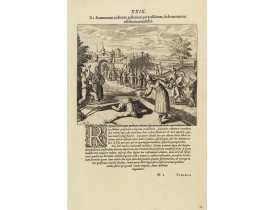
Location: 1599
Published: Frankfurt, 1599
Size: 140 x 177mm.
Color: Uncoloured.
Condition: Text sheet with copper plate engraving (140x177mm.) In very good condition, dark impression.
The Chinese way of a punishment from Linschoten's famous voyages to the East of 1583-92 here published by De Bry the year aft..
100€
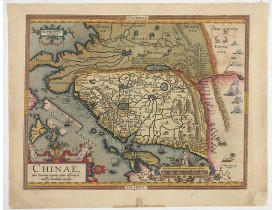
Location: 1608
Published: Antwerp, 1608
Size: 365 x 470mm.
Color: Coloured
Condition: 4to. 2 parts in one vol. General title with woodcut printers device, two section titles with diagrams of globes, 32 woodcut diagrams in the text. Very light marginal browning. Contemporary vellum, lightly stained.
The first map of China ever to appear in a Western atlas, west to the top. When this map appeared, it was by far the most acc..
5,500€
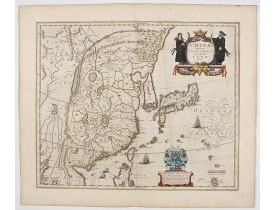
Location: 1644
Published: Amsterdam, 1644
Size: 410 x 500mm.
Color: In attractive strong original colours.
Condition: Fine condition.
This was the first of Blaeu's maps of China. In 1655 he was to publish the famous map of Father Martini, with many of the ear..
2,200€
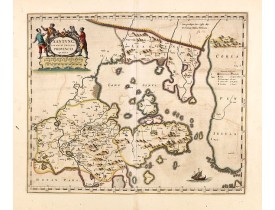
Location: 1660
Published: Amsterdam, ca 1660
Size: 396 x 480mm.
Color: In very attractive original colours.
Condition: Very good condition. Paper very slightly age-toned and some light offsetting due to oxidation of ink.
A map of the northern province ‘Xantung’ of China after the Jesuit Martino Martini.Shows the Great Wall and is centered on th..
1,400€
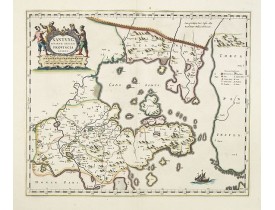
Location: 1660
Published: Amsterdam, ca 1660
Size: 396 x 480mm.
Color: In original colours.
Condition: Very good condition. Good and dark impression.
A map of the northern province ‘Xantung’ of China after the Jesuit Martino Martini.Shows the Great Wall and is centered on th..
1,200€
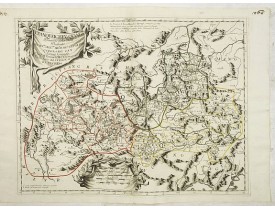
Location: 1690
Published: Venice, 1690
Size: 450 x 590mm.
Color: In original o/l colours.
Condition: Good and dark impression. Unusual to find a Coronelli map in original out line colours.
A beautiful map depicting the area of Beijing with decorative title cartouche and scale cartouche. Information about the area..
600€
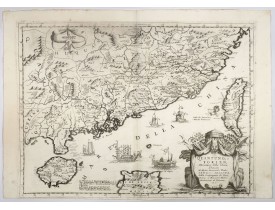
Location: 1691
Published: Venice, 1691
Size: 452 x 605mm.
Color: Uncoloured.
Condition: Short lower margin. A strong impression printed on thick paper. Italian description on verso.
A beautifully engraved decorative map of Southern China extending from Hainan in the West to Formosa in the East and centered..
3,500€
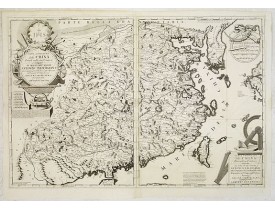
Location: 1695
Published: Venice, 1695
Size: 605 x 910mm.
Color: Uncoloured.
Condition: Some very minor re-inforcements along center fold. A good and dark impression. Very good condition.
The map depicts the eastern part of China with Korea -correctly- as a peninsula. Formosa is included as well. Japan is partly..
7,500€
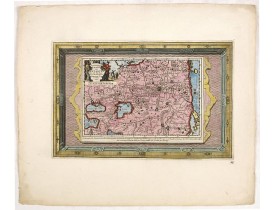
Location: 1713
Published: Amsterdam, 1713
Size: 215 x 335mm.
Color: Coloured.
Condition: Map has two small holes that affect the engraved surface, one is a rust hole light creasing and the margins have very minor nicks and small tears, else in good condition.
This attractive map of Tartary shows the ancient Silk Road region. The map shows the track of William of Rubruck (Willem van ..
500€
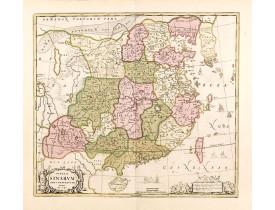
Location: 1720
Published: Amsterdam, ca. 1720
Size: 462 x 520mm.
Color: Original colours.
Condition: In mint condition and very attractive original colours.
Schenk and Valk's rare early 18th century issue of Janssonius milestone map of China, Korea and Japan after Martino Martini. ..
1,700€
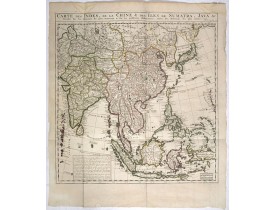
Location: 1720
Published: Amsterdam, 1720
Size: 512 x 490mm.
Color: In original o/l colours.
Condition: A good and dark impression. Very good. Rare to find in original colours.
This delicate and quite detailed general map extends from northern Japan to Timor and from India to New Guinea.Here, the Terr..
700€
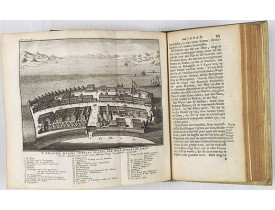
Location: 1729
Published: Amsterdam, 1729
Size: 200 x 125mm.
Color: Uncoloured.
Condition: 6 parts in one vol. 8vo. Contemporary blind tooled vellum, title in ink on spine. Engraved allegorical frontispiece by J.C. Philips (1729), 3 engraved folding maps of (1) China, including Japan and Kamchatka, (2) Japan.
Original edition of the first volume of the Dutch translation of an extensive series on the geography, history and culture of..
1,300€
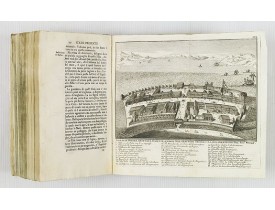
Location: 1734
Published: Venice, 1734
Size: 200 x 130 mm.
Color: Uncoloured.
Condition: 8vo. Contemp. vellum. 512pp. Illustrated with 4 plates including one with Japanese people. 1 folding view of Deshima and two folding maps of Japan and the Philippines with Italian text after I. Tirion.
This most uncommon work provides an interesting focus on the dissemination of the outline of Japan provided by Kaempfer. Besi..
1,000€
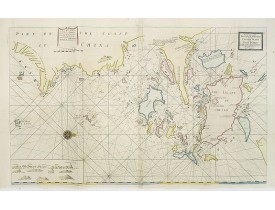
Location: 1734
Published: London, William Mount & Thomas Page, 1734
Size: 518 x 865mm.
Color: Coloured.
Condition: In very good condition.
A very fine sea chart of China's Zhejiang Province, from the celebrated Third Book of 'The English Pilot'This elegant and lar..
2,500€
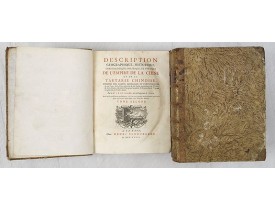
Location: 1736
Published: The Hague, H. Scheurleer, 1736
Size: 560 x 410mm.
Color: Uncoloured.
Condition: 4 volumes, 4to (257 x 196mm.), titles printed in red and black with engraved vignettes, 11 engraved vignette illustrations and 51 plates (of 53), a number folding, contemporary half calf, spines gilt with morocco labels, [Löwendahl 398], without the separately published atlas, lacking 2 plates in vol.2 (Obseques at p.149 and Gin seng at p.180), one plate torn without loss (vol.1, p.230), d4 vol.1 with short tear and slight stain, bindings slightly rubbed and slightly worn.
These volumes accompany Bourguignon d'Anville's Nouvel atlas de la Chine, de la Tartarie chinoise et du Thibet. of 1737. Firs..
5,000€
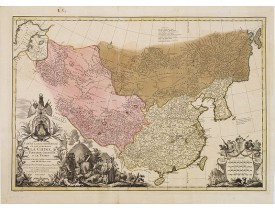
Location: 1737
Published: The Hague, 1737
Size: 470 x 685mm.
Color: In original colours.
Condition: Paper broken on centerfold and other places due to oxidation of green ink. Good and dark impression.
It has a quite elaborate pictorial cartouche engraved by G. Kondet. It is a very detailed map of China, Tibet, and Korea.In t..
2,500€
![HASE, J, M. - [ Four plans on one sheet] Han Tscheu, Sinngan Fou (Singapore??), Kan Tscheu and Su Tscheu.](https://www.loeb-larocque.com/eshop/image/cache/catalog/image/new_upload/33498-275x210h.jpg "HASE, J, M. - [ Four plans on one sheet] Han Tscheu, Sinngan Fou (Singapore??), Kan Tscheu and Su Tscheu.")
Location: 1739
Published: Nuremberg, Homann, c. 1739
Size: 295 x 177mm.
Color: In original colours.
Condition: Wide left margin, right margin cut close. Dark impression. Fine.
A rare composite sheet of engravings of town-plans of Han Tscheu, Sinngan Fou (Singapore??), Kan Tscheu and Su Tscheu. ..
350€
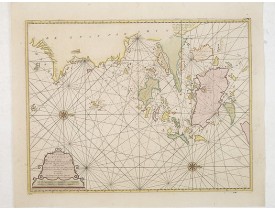
Location: 1753
Published: Amsterdam, 1753
Size: 410 x 535mm.
Color: In original colours.
Condition: Paper slightly age-toned. Several wormholes filled in, hardly notable. Very good throughout.
A rare and finely engraved and detailed chart of China's Zhejiang Province. Very rare: only included in 6th volume (so-called..
4,500€
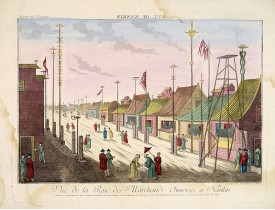
Location: 1760
Published: Augsburg, 1760
Size: 310 x 410mm.
Color: Original colours.
Condition: In very attractive original colours. Light water stain in margins affecting engraved area.
So-called optical print illustrating a parade of vessels. Engraved by F.X. Habermann (1721-1796). The Academie Imperiale was ..
400€
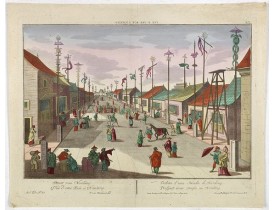
Location: 1760
Published: Augsburg 1760
Size: 310 x 410mm.
Color: Original colours.
Condition: In very attractive original colours. Good margins.
A well-known publisher of optical prints, established in Augsburg. After a design by P.van Blankaert.In the eighteenth and ni..
350€
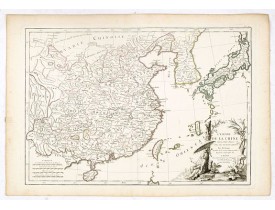
Location: 1783
Published: Paris, ca 1783
Size: 302 x 445mm.
Color: In original o/l colours.
Condition: Paper slightly age toned, with good margins. Good impression.
Attractive map of eastern part of China, including Taiwan, Korea and Japan. With ornamental title cartouche. Boundaries outli..
275€