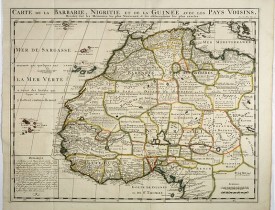
CHATELAIN, H. - Carte de la barbarie, Nigritie et de la Guinée avec les pays voisins . . .
Click on image to zoom
New
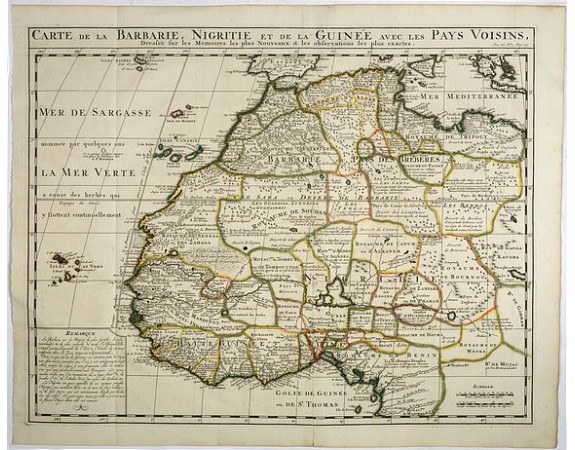
CHATELAIN, H. - Carte de la barbarie, Nigritie et de la Guinée avec les pays voisins . . .
Published: Amsterdam, 1720
Size: 398 x 508mm.
Color: Coloured.
Condition: Very good impression.
Description
Showing the imaginary island of ''Borondon'' or Saint Brendan's Island, also known as Saint Brendan's Isle, supposedly situated in the North Atlantic somewhere west of Northern Africa. It is named after Saint Brendan of Clonfert. He and his followers are said to have discovered it while travelling across the ocean and evangelising its islands. It appeared on numerous maps from Christopher Columbus's time through the 18th century.
This great map of western Africa is based on Guillaume Delisle's map. It covers from the Barbary coast to below the equator. There is a mass of geographic detail and annotations in the interior, including information on the rivers and lakes.
Numerous tent encampments are depicted throughout the Sahara Desert.
Henri Abraham Chatelain (1684 – 1743) was a Huguenot pastor of Parisian origins. He lived consecutively in Paris, St. Martins, London (c. 1710), the Hague (c. 1721) and Amsterdam (c. 1728). He is best known as a Dutch cartographer, and more specifically for his contributions to the seminal seven-volume Atlas Historique, published from 1705 to 1720.
The atlas, though published anonymously, is generally known to have been the work of the Chatelain family. Groundbreaking for its time, this work included studies of geography, history, ethnology, heraldry, and cosmography.
This great map of western Africa is based on Guillaume Delisle's map. It covers from the Barbary coast to below the equator. There is a mass of geographic detail and annotations in the interior, including information on the rivers and lakes.
Numerous tent encampments are depicted throughout the Sahara Desert.
Henri Abraham Chatelain (1684 – 1743) was a Huguenot pastor of Parisian origins. He lived consecutively in Paris, St. Martins, London (c. 1710), the Hague (c. 1721) and Amsterdam (c. 1728). He is best known as a Dutch cartographer, and more specifically for his contributions to the seminal seven-volume Atlas Historique, published from 1705 to 1720.
The atlas, though published anonymously, is generally known to have been the work of the Chatelain family. Groundbreaking for its time, this work included studies of geography, history, ethnology, heraldry, and cosmography.
200€
- See other items by this publisher: CHATELAIN, H.
- Reference N°: 39101